Questions UC nursing students ask before hiring placement help
Before hiring help with a UC clinical placement, most students want a few things settled: how we work alongside UC, how we get a preceptor ready for UC's review, and what happens when timing or a preceptor goes wrong. Here are straight answers, drawn from UC's own documents where UC is involved.
Get your UC placement plan
Your UC track and where you live. A placement advisor replies with what a UC-ready preceptor and site look like for you.
Are you part of the University of Cincinnati?
We're an independent placement service, built specifically for UC nursing students and UC's clinical rules. We work alongside your Clinical Site Coordinator, your course faculty and your program director, each of whom keeps their own role in your placement.
UC expects graduate students to find and secure their own preceptors, and we take that search on with you: looking for a clinician and site that fit your track, then helping you gather what the Clinical Site Coordination team reviews. UC gives the final approval on every preceptor, site and affiliation agreement, and we make sure what reaches the team is complete. The how it works page shows where each piece falls, step by step.
Will UC accept a preceptor you find?
UC vets every preceptor the same way, however they were found, and that's exactly why we screen first. Before your packet goes in, we check each candidate against the rules UC applies, so the usual grounds for a refusal surface early:
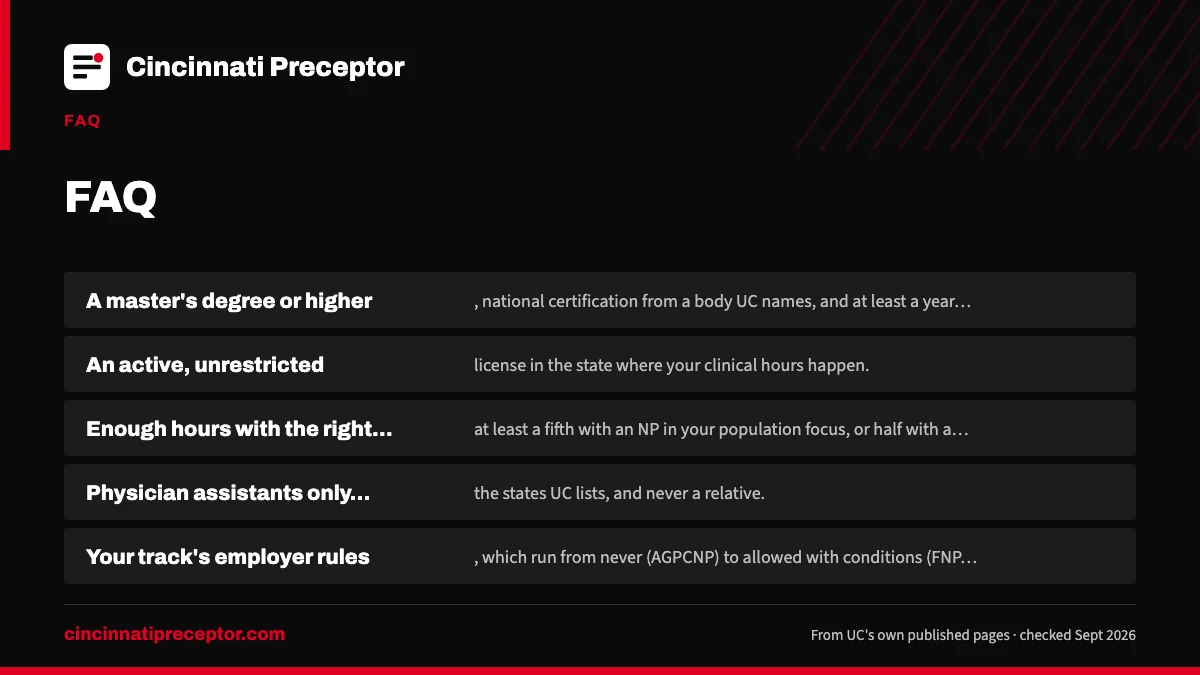
- A master's degree or higher, national certification from a body UC names, and at least a year in the role.
- An active, unrestricted license in the state where your clinical hours happen.
- Enough hours with the right clinician: at least a fifth with an NP in your population focus, or half with a CNM or CM for midwifery.
- Physician assistants only in the states UC lists, and never a relative.
- Your track's employer rules, which run from never (AGPCNP) to allowed with conditions (FNP, midwifery).
If UC still turns someone down, the preceptor not approved page covers the usual reasons and what to do next.
How early should I reach out?
Count back from the packet deadline for your course's term. Spring courses need the packet by the first Friday in October, summer courses by the first Friday in February, and fall courses by the last Friday in May. The Preceptor Guide puts the same deadline at three months before the term. Your preceptor has to agree and complete their section before that date, so the search belongs well ahead of it.
Coming to us earlier gives room for a first choice to decline and for a site's paperwork to move. Coming later isn't hopeless, but it narrows what's possible, and UC notes it can't promise agreements for late packets. If your term has already started, the end of week 2 is the line that matters; see need a preceptor fast for how to triage.
What if my preceptor drops out?
We stay on call for this. If a preceptor withdraws, whether before the packet deadline or partway through the term, tell your CSC the same day and tell us. We start looking for a replacement that fits the same course, setting and hours, near where you already train if the area allows.
A replacement isn't a simple swap in UC's system. The new preceptor needs their own Preceptor Application and UC's approval, and a different site may need its own affiliation agreement and onboarding. If the term has begun, all of that still has to clear by the end of week 2. Keep your eMedley hours verified as you go so the time you've already worked is on record. The preceptor dropped out page has a fuller plan.
Which states can I do UC clinicals in?
Seven states are closed to UC graduate clinicals: New York, Massachusetts and Rhode Island in the Northeast, Tennessee and Louisiana in the South, and Arizona and Oregon in the West. Washington is closed to DNP students as well. Clinicals can't happen in U.S. territories, at embassies or abroad; a U.S. military base is the exception, with a contract that can take six months to a year and isn't assured.
Some tracks are narrower still. The AGACNP programs, the AGPCNP certificate and the PNP acute care certificate are open only to Ohio, Kentucky and Indiana residents. If you'll train in California, North Dakota or Wyoming, extra state forms must reach constateauth@uc.edu no later than a week before the semester starts. In every case you need an RN license valid where you train. The state authorization page has the detail.
What working with us looks like
Students who work with us get a search built around their track and location, every candidate screened against UC's rules before they hear the name, and the Preceptor Application details and site contact ready ahead of the packet Friday. Through the term, a placement advisor stays on call, and if a preceptor withdraws, the replacement search starts at once.
The steps that belong to UC stay with UC: your CSC gives the final approval, the site's legal team signs the agreement, and your own Critical Requirements keep you eligible. Getting the file right makes each of those go more smoothly. UC suggests questions to put to any placement service about cost, refunds and vetting, and we answer every one; the choosing a placement service page lays them out, and the cost page explains how our written quote works.
Questions UC students ask
Do you help RN-to-BSN students?
We can talk it through. UC's online RN-to-BSN includes a direct-care experience in NBSN4081 Focus on Community, but UC doesn't publish how many hours it needs or who arranges it. Ask your course faculty or advisor what's expected first, then tell us what they said and where you live.
Can you help post-master's certificate students?
Yes. Certificate plans at UC are individualized after a transcript review, so tell us your plan's internship courses and hours. Practicing NPs in the FNP certificate need at least two preceptors rather than three, and the AGPCNP and PNP acute care certificates accept only Ohio, Kentucky and Indiana residents.
Can I do clinicals where I work?
It depends on your track. AGPCNP students can't use their employer as a site. FNP students can, but not in their own department or under a supervisor. Midwifery students may with the Precepting in the Setting Where You Work form and program director approval, and some PNP acute care students may use their own unit.
Could a physician be my preceptor?
Often, yes. UC accepts MD and DO preceptors with relevant expertise in most tracks, as long as the NP-hours floor is still met: 20% with an NP in your population focus, or half with a CNM or CM in midwifery. PMHNP Internship I is different and needs a licensed psychotherapy provider.
Can you find me a placement in Cincinnati itself?
If Cincinnati is where you live, that's where we search. Local systems each run their own process; Cincinnati Children's, for example, wants NP students to hold an active Ohio RN license and complete its APRN Clinical Placement Interest Form. AGACNP DNP students should talk to their CSC first, since that program's page says local students are assured Cincinnati-area preceptors.
What has to be done before my first clinical day?
Your Critical Requirements must be current, your RN license must cover the clinical state, UC's welcome email must have arrived, the affiliation agreement must be in effect and the site's onboarding must be finished. UC's Critical Requirements page currently says CastleBranch purchases are on hold, so ask your CSC what to do if you haven't ordered yet.
Related pages
Last checked 2026-09-24
We check these pages against UC's own sources. Your Clinical Site Coordinator, your course faculty and UC's current documents have the final word.
Hand us the search. Keep your packet deadline.
Tell us your UC track, where you live and which term your next practicum starts. We look for a preceptor and site that fit UC's rules for your track, and help you get the Preceptor Application and agreement details right.
- Matched to your track's population, setting and hour rules
- Checked against UC's preceptor requirements before your CSC sees it
- Aimed at UC's packet deadline, not just the first day of term
Start your placement plan
A placement advisor replies with what a UC-ready preceptor and site look like for you.