Preceptors for the UC online FNP
UC's online FNP asks you to find the preceptors for 672 outpatient hours across three practicums, ANNP8070, ANNP8072 and ANNP8074, and to spread those hours over women's health, pediatrics and adult primary care. You need at least three different preceptors, 60 or more hours with each, and every one vetted by UC's Clinical Site Coordination team before your first shift. Planning the population mix before you make calls is what keeps the search manageable.
Get your UC FNP placement plan
Tell us your state and which FNP practicum is next. A placement advisor replies with the preceptor types and settings that fit UC's rules for that term.
672clinical hours in UC's FNP track
3different preceptors at minimum
150hours with an NP or CNM
60hours minimum with each preceptor
How UC's FNP is set up
UC offers the family nurse practitioner track three ways: an online MSN, a BSN-to-DNP and a post-master's certificate. The MSN is listed at 51 credit hours and runs about two years over six semesters, with asynchronous coursework and in-person precepted clinicals. Classes start three times a year; the next listed starts are Jan 11, May 10 and Aug 23, 2027.
Online does not mean you never travel. From Spring 2027, NURS8020C Advanced Health Assessment includes a three-day immersion on the Cincinnati campus. UC's FNP curriculum page still describes the program as fully online with no site visits, but the campus-visits page is newer, so plan for the trip. The health assessment immersion page has the dates.
The FNP DNP uses the same three practicums in semesters 6 to 8, starts in fall only, runs about three years and adds the DNP's 500 project practicum hours. The certificate swaps the practicums for internships ANNP8086 to ANNP8089 on an individual plan; see post-master's certificates. In any version, UC can't host your clinicals in seven states, and the DNP rules out Washington as well; state authorization has the names.
The three practicums at a glance
Every FNP clinical hour is outpatient or ambulatory, capped at 40 hours a week, and logged inside the term it belongs to. If you log more than a practicum requires, up to 32 extra hours can carry forward to the next one. The course-by-course rules are on UC FNP practicums; this is the summary for planning.
| Course | Semester | Hours | What the course adds |
|---|---|---|---|
ANNP8070 Practicum I | 4 | 168 | Primary care across the lifespan |
ANNP8072 Practicum II | 5 | 224 | Differential diagnosis of acute and chronic problems |
ANNP8074 Practicum III | 6 | 280 | Evaluating care and taking on the full APN role |
Across the three courses, UC wants 150 hours in women's health (up to 60 of them in a specialty or ambulatory clinic), 200 in pediatrics (up to 100 in an outpatient specialty clinic) and 322 in adult primary care (up to 90 in a specialty). Urgent care, fast track, retail clinics and emergency departments can supply no more than 120 hours between them. Pediatric and women's health hours can't begin until you've finished ANNP8062 and ANNP8063; the FNP FAQ also names ANNP8060 as an alternative.
Who can precept a UC FNP student
Each FNP preceptor has to clear UC's college-wide bar and the FNP list on top of it. The general standards are on UC preceptor requirements. For this track the rules come down to the following.
- A nurse practitioner, certified nurse-midwife or WHNP, or an MD or DO who practices primary care.
- Certification from ANCC, AANPCB, PNCB, AACN, NCC or AMCB, plus the degree, experience and licensure UC expects of everyone.
- Not a clinical nurse specialist, and not someone whose credential is CPM, LM or CM.
- At least 60 hours with each preceptor and at least three different preceptors over the program, or two for post-master's students who already practice as NPs.
- An NP or CNM supervising 150 or more of the 672 hours, a rule UC waives for students who already practice as NPs.
- No single preceptor across all three semesters, and no family members, in-laws included.
Physician assistants are an option only in the states UC names, and even there UC limits their hours and decides each one individually; PA preceptors has the list.
Your workplace, telehealth and your license
FNP is one of the tracks that lets you train at your employer, with two limits: not in your own department or unit, and not under anyone who supervises you. A nurse practitioner in a different clinic of the same organization can be a sensible first call. Other tracks handle this differently; clinicals where you work compares them.
Telehealth time can count if the program director approves it for your situation. As an FNP student you sit in the clinic beside the preceptor for those visits; joining from home isn't an option.
You'll need an RN license for each state you train in. Kansas APRN admits also take NURS8098 Clinical Elective, whose variable credits cover the additional hours that state's nursing board expects. Preceptors in California, North Dakota and Wyoming complete extra state forms that travel separately from the packet; state preceptor forms covers them.
Where the FNP search gets hard
The total is rarely the problem; the mix is. A family practice that sees all ages can cover adult hours and some pediatric time, but reaching 200 pediatric hours and 150 women's health hours usually takes preceptors chosen for those populations. Add the 60-hour floor per preceptor and the three-preceptor minimum, and the plan has to be built by population, not just by term.
Timing tightens it. Each practicum's packet is due months ahead, UC's standard agreement alone needs six weeks or so, and a clinic whose lawyers want their own contract can hold things up for half a year or more. A preceptor who first says yes in July for a fall practicum has already missed UC's May packet date.
Retail and hospital systems add a wrinkle. The Little Clinic and Nationwide Children's, for example, are on UC's list of organizations you approach only through your CSC, which matters for FNPs chasing urgent care or pediatric hours; site onboarding has the full list.
Plan pediatric and women's health hours by name. A preceptor who sees a few children won't reliably get you to 200 pediatric hours, and those hours can't start until ANNP8062 and ANNP8063 are done.
Planning the search against UC's deadlines
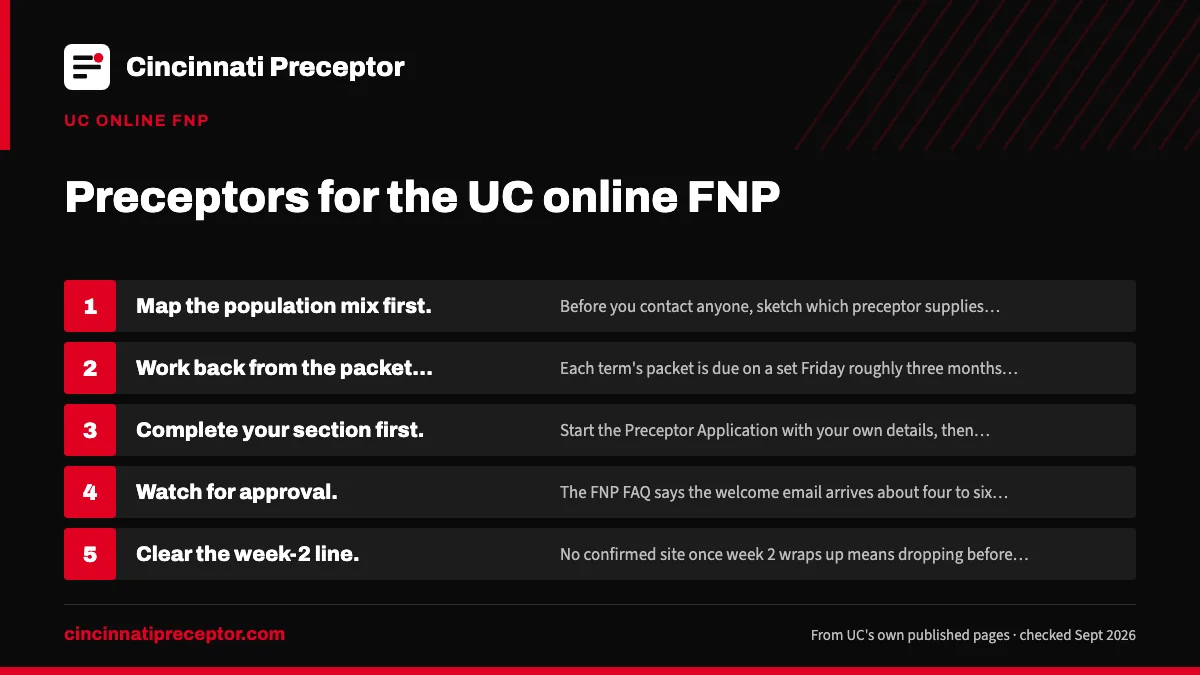
- Map the population mix first. Before you contact anyone, sketch which preceptor supplies women's health, pediatric and adult hours, and in which practicum. Keep every preceptor at 60 hours or more and your NP or CNM total at 150 or more.
- Work back from the packet deadline. Each term's packet is due on a set Friday roughly three months out, and packet deadlines keeps the dates. For a fall practicum that means late May.
- Complete your section first. Start the Preceptor Application with your own details, then hand it to the preceptor to finish and email. Send it to whichever address your CSC confirms, because UC's documents disagree.
- Watch for approval. The FNP FAQ says the welcome email arrives about four to six weeks before the term, and your preceptor then appears in eMedley. The email can list extra site requirements.
- Clear the week-2 line. No confirmed site once week 2 wraps up means dropping before the drop date is the safe move, since staying enrolled risks an administrative withdrawal or a failing grade. The week-2 rule explains it.
Where we fit: we search for family, pediatric and women's health preceptors near you who meet these rules, help you gather what the Preceptor Application and agreement ask for, and stick with the search if a preceptor leaves mid-term. Vetting and approval stay with your CSC and UC. See how it works or use the form on this page.
Questions UC students ask
Can I use the same preceptor for all three UC FNP practicums?
No. UC's FNP rules bar using one preceptor across all three semesters and require at least three different preceptors overall, or two if you are a post-master's student already practicing as an NP. You can keep a strong preceptor for two practicums and add others, as long as each one gives you at least 60 hours.
Do urgent care hours count toward UC's FNP clinicals?
Yes, up to a cap. Urgent care, fast track, retail clinics and emergency departments together can count for no more than 120 of your 672 hours. Everything else has to be outpatient or ambulatory care, including the women's health, pediatric and adult primary care hours UC requires.
Can a certified nurse-midwife precept a UC FNP student?
Yes. CNMs are on UC's FNP preceptor list alongside NPs, WHNPs and primary care physicians, and they can be a practical route to women's health hours. A clinical nurse specialist can't precept FNP students, and neither can someone whose only credential is CPM, LM or CM.
When does UC confirm an FNP preceptor is approved?
UC's FNP FAQ says the confirmation email usually arrives about four to six weeks before the term, once the Clinical Site Coordination team has vetted the preceptor and the site paperwork is moving. The preceptor then shows up in eMedley. If the term is close and nothing has arrived, ask your CSC before you log any hours.
Is the UC online FNP fully online?
Coursework is online and asynchronous, but clinicals are in person with your preceptor, and starting Spring 2027 you spend three days in Cincinnati for the NURS8020C immersion. Listed dates include Apr 12–14, Jul 26–28 and Nov 15–17, 2027. The curriculum page that says no site visits are required predates this change.
Related pages
FNP practicums and hoursUC's FNP practicums, ANNP8070, ANNP8072 and ANNP8074, carry 672 outpatient hours across women's health, pediatric and adult care. The rules, course by course.UC preceptor requirementsUC's preceptor rules: master's or higher, accepted certification, a year in the role, a clean license in the clinical state, and the 20% NP and 50% CNM rules.UC preceptor packet deadlinesUC's preceptor packet deadlines: last Friday in May (fall), first Friday in October (spring), first Friday in February (summer), and what a late packet risks.Clinicals at your employerCan you do UC clinicals at your employer? AGPCNP students can't, FNP students can outside their own department, and midwifery needs a signed workplace plan.Post-master's NP certificatesUC's post-master's NP certificates: individualized FNP internships, OH/KY/IN residency for AGPCNP, AGACNP and PNP-AC, and the PMHNP virtual intensive.BSN-to-DNP NP tracksUC's BSN-to-DNP NP tracks pair the specialty clinicals with 500 DNP practicum hours, start in fall only and run three years. How to plan the preceptor search.
Last checked 2026-09-24
We check these pages against UC's own sources. Your Clinical Site Coordinator, your course faculty and UC's current documents have the final word.
Hand us the search. Keep your packet deadline.
Tell us your UC track, where you live and which term your next practicum starts. We look for a preceptor and site that fit UC's rules for your track, and help you get the Preceptor Application and agreement details right.
- Matched to your track's population, setting and hour rules
- Checked against UC's preceptor requirements before your CSC sees it
- Aimed at UC's packet deadline, not just the first day of term
Start your placement plan
A placement advisor replies with what a UC-ready preceptor and site look like for you.