Doing your UC clinicals where you work
It depends on your track. UC's AGPCNP guide rules out your employer as a clinical site, the FNP rules allow your employer but not your own department or a supervisor as preceptor, and nurse-midwifery students may train at work once the program director approves a written plan. Every track shares two limits: no relatives as preceptors, and no training in the clinic or unit that employs you, except where a track permits it and the program director agrees.
Get your UC placement plan
Your UC track and where you live. A placement advisor replies with what a UC-ready preceptor and site look like for you.
The rule that covers every UC track
UC's Clinical Preceptor Guide (revised May 2026) sets limits that apply whatever you study. A relative may not precept you. You can't train in the clinic or unit where you hold a job or already practice as an APRN, unless your track permits it and the program director signs off. And no hours count at any site, your employer included, until a site agreement is in place.
Track documents then tighten or loosen the middle rule. Some forbid the employer outright; others allow it but draw the line at your own department or your boss. The student section of the Preceptor Application asks whether you work for the organization, so your CSC sees the connection either way. Raising it before the packet goes in is simpler than explaining it after.
The table below sets out what each track's current document says. Where a track is silent, the college-wide rule above still applies.
Track by track
| Track | At your employer? | The limit |
|---|---|---|
| FNP | Yes | Not your own department or unit; your preceptor can't supervise you |
| AGPCNP | No | Your site of employment can't be a clinical site |
| AGACNP | Not ruled out | Not in your own department; no relatives |
| Nurse-Midwifery | Yes, with a plan | Workplace form signed; an own-department preceptor needs director approval |
| WHNP | Not ruled out | An own-department preceptor needs director approval and is discouraged |
| PNP Acute Care | For some students | Some can count hours on their own unit |
| NNP | Not ruled out | Not in your own department; no relatives |
| PMHNP | No track rule found | College-wide limits apply; ask your CSC |
"Not ruled out" means the track document limits the department rather than the employer. A different department in your hospital may work, but confirm the exact setup with your CSC before you ask a colleague to precept.
FNP: your employer yes, your department and your boss no
The FNP FAQ (revised May 2026) lets you do clinical hours with your employer, which helps students who work for a large system with many outpatient practices. Two limits apply. The site can't be your own department or unit, and your preceptor can't be someone who supervises you.
A hospital nurse could therefore rotate through the system's family practice or pediatric clinic with an NP there, as long as nobody in that clinic manages them. The standard FNP rules sit on top: every hour outpatient, 60 or more with each preceptor, three or more preceptors in all, and no single preceptor for all three practicums. The course hours are on FNP practicums.
AGPCNP: never your place of employment
The AGPC Clinical Planning Guide (July 2026) is the strictest document UC publishes on this. AGPCNP students "may not use their site of employment as a clinical site." The guide also rules out relatives and any supervisor in your own department.
That closes the route many working nurses count on, so AGPCNP students need outside leads from the start. The guide doesn't define "site of employment" for a large system with many locations. If you work at one hospital in a system and have your eye on an outpatient clinic elsewhere in the same system, ask your CSC before you ask the preceptor, and keep the answer in writing.
The rest of the AGPC rules still shape the search: outpatient hours only, at least 80 hours per preceptor, at least four hours a day, and at least three preceptors and practice locations across the program.
Nurse-midwifery: the workplace form
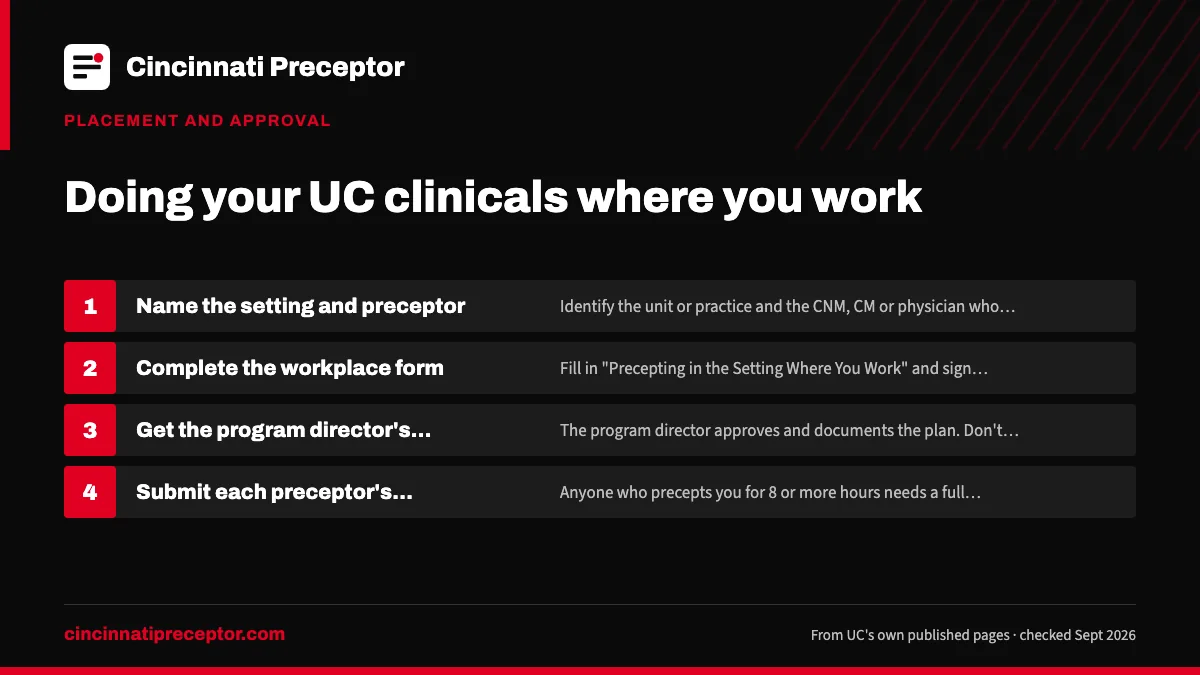
Midwifery is the track most open to training at work. UC's nurse-midwifery requirements allow clinical hours at your workplace, and UC posts a form for it, "Precepting in the Setting Where You Work." You and the program director both sign it, and the program director must approve and document the plan.
- Name the setting and preceptorIdentify the unit or practice and the CNM, CM or physician who would precept you. A preceptor in your own department needs program director approval.
- Complete the workplace formFill in "Precepting in the Setting Where You Work" and sign it. The posted version dates from 2022, so ask your CSC whether a newer one exists.
- Get the program director's sign-offThe program director approves and documents the plan. Don't start hours before that.
- Submit each preceptor's applicationAnyone who precepts you for 8 or more hours needs a full Preceptor Application, and midwifery preceptors also send a CV.
Working where you train doesn't change the supervision floor: at least half of your hours must be with a CNM or CM. Nurse-midwifery clinicals has the course-by-course detail.
PNP-AC, WHNP, AGACNP and NNP: department limits
UC's preceptor FAQ notes that some PNP Acute Care students can count hours on their own unit, one of the few places UC names your own unit as a possibility. Treat it as an exception to confirm, not a default. Ask your CSC and the program director before you plan a term around it.
The WHNP requirements allow a preceptor from your own department only with program director approval, and call the arrangement generally discouraged. The AGACNP and NNP requirements both rule out relatives and your own department. None of the three bars your employer outright, so another department in your hospital may be possible, subject to the college-wide rule and your CSC's review.
For PMHNP students, the documents we reviewed contain no track-specific employer rule. The college-wide limits apply, and your CSC is the person to ask before you approach a colleague.
Working for the organization is something UC asks about on the Preceptor Application. Tell your CSC early, while there's still time to change course.
Leadership, education and DNP project settings
Non-NP tracks handle work differently. Systems Leadership preceptors need to sit at least one administrative rung above you. The Public Health Nursing DNP requirements (revised 2022) say a preceptor at your employer must rank at least one level above you. MSN Nursing Education students may not earn practicum hours during paid work time.
The post-MSN DNP runs the other way. UC's DNP FAQ says students' work environments often make an ideal setting for the DNP project, and most post-MSN DNP students keep working full time. That is a project site, not an NP rotation, so the NP employer rules above don't govern it. See the DNP project practicum for how the 500 practicum hours work.
Questions UC students ask
Can a UC FNP student do clinicals at their own hospital?
Yes, within limits. UC's FNP FAQ allows clinical hours with your employer as long as you aren't in your own department or unit and your preceptor doesn't supervise you. All FNP hours must be outpatient, so a hospital employer usually means one of its clinics or practices rather than an inpatient floor.
Why can't AGPCNP students use their employer?
UC's AGPC Clinical Planning Guide states the rule without giving a reason: students may not use their site of employment as a clinical site. Because the rule is firm, plan outreach outside your own organization from your first semester, and ask your CSC how it applies if you work for one part of a large health system.
Can my manager or a coworker precept me?
A manager, no. FNP rules bar a preceptor who supervises you, and the AGPC guide excludes any supervisor from your own department. A coworker in your own department is also usually out, since most tracks exclude your own department. WHNP and midwifery allow an own-department preceptor only with program director approval.
Do I have to tell UC that I work at my clinical site?
Yes. The Preceptor Application's student section asks whether you work for the organization, and your CSC reviews the answer against your track's rules. Leaving it out risks the preceptor or site being turned down later, when there's less time to replace them. Raise the arrangement with your CSC before the packet goes in.
Can a relative precept me if they work at a different site?
No. UC's Preceptor Guide bars relatives as preceptors on every track, and the FNP requirements extend that to family by marriage. Where the relative works doesn't change the rule. If a relative offers to introduce you to a colleague, check with your CSC that the colleague is independent enough to precept you.
Related pages
Last checked 2026-09-24
We check these pages against UC's own sources. Your Clinical Site Coordinator, your course faculty and UC's current documents have the final word.
- UC College of Nursing: Clinical Preceptor Guide, Graduate Programs (May 2026)
- UC College of Nursing: FNP clinical FAQ (May 2026)
- UC College of Nursing: AGPC Clinical Planning Guide (July 2026)
- UC College of Nursing: Precepting in the Setting Where You Work (nurse-midwifery)
- UC College of Nursing: preceptor FAQ
Hand us the search. Keep your packet deadline.
Tell us your UC track, where you live and which term your next practicum starts. We look for a preceptor and site that fit UC's rules for your track, and help you get the Preceptor Application and agreement details right.
- Matched to your track's population, setting and hour rules
- Checked against UC's preceptor requirements before your CSC sees it
- Aimed at UC's packet deadline, not just the first day of term
Start your placement plan
A placement advisor replies with what a UC-ready preceptor and site look like for you.