The UC Educational Affiliation Agreement: standard form, site contracts and timing
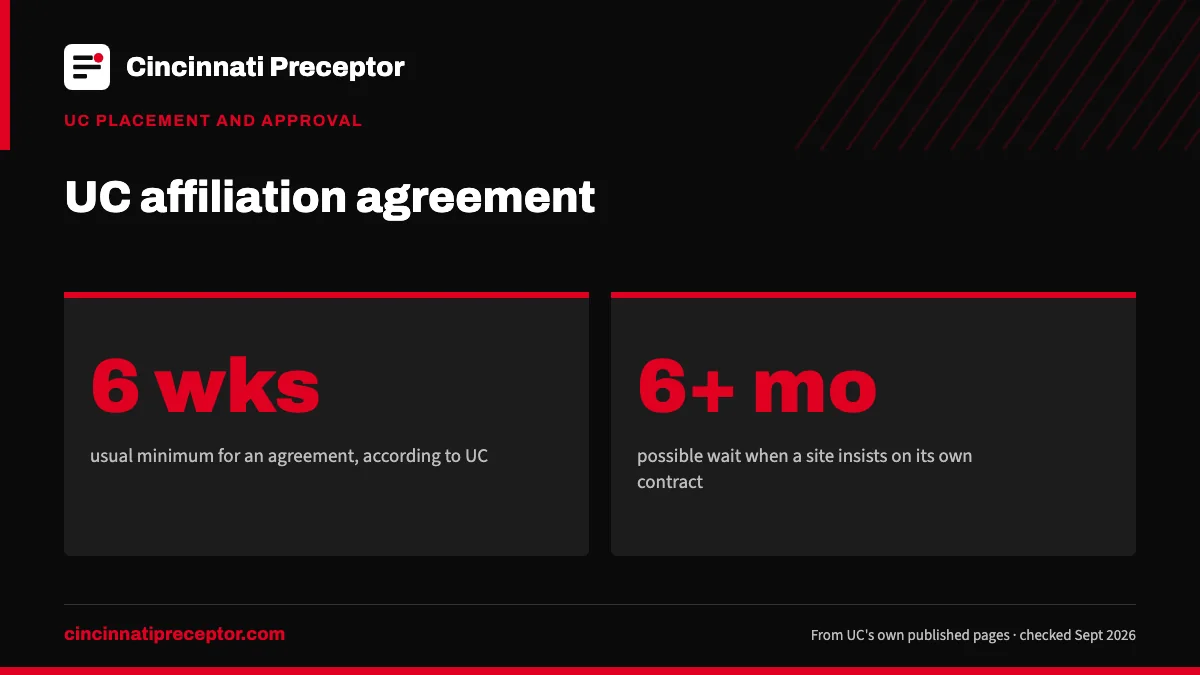
Every UC clinical rotation needs an Educational Affiliation Agreement between UC and the site, in effect before you see a patient. In most cases your CSC emails UC's standard agreement, which UC's Office of General Counsel has already approved, to the site's administrative contact, and UC says that route usually takes at least six weeks. If the site insists on its own contract, the two legal teams negotiate, and UC warns that can take six months or longer.
Get your UC placement plan
Your UC track and where you live. A placement advisor replies with what a UC-ready preceptor and site look like for you.
6 wksusual minimum for an agreement, according to UC
6+ mopossible wait when a site insists on its own contract
What the agreement is and why it gates everything
The Educational Affiliation Agreement (EAA) is the contract that lets UC students train at a given site. UC's Clinical Planning page says agreements are required for all clinical rotations, and the May 2026 Preceptor Guide says the site agreement must be in effect before clinical activity begins. No hours count at a site that lacks one.
It is a separate thing from your preceptor's approval. The Preceptor Application vets the person; the agreement binds the organization. You can hold a welcome email for an approved preceptor and still be unable to start because the site hasn't finished its side of the contract.
One older UC document says something different. A 2022 networking guide stated that UC didn't require an agreement, but UC's current pages say one must be in place, so treat the 2022 line as out of date.
UC's standard agreement or the site's own
| UC's standard agreement | The site's own contract | |
|---|---|---|
| Who drafts it | UC, with approval from UC's Office of General Counsel | The site's legal team |
| How it starts | Your CSC emails it to the site's administrative contact | The site puts forward its terms and the two legal teams negotiate |
| UC's stated timing | Usually at least 6 weeks | Up to six months or longer |
| What to plan for | Workable when the packet meets its deadline | Start a term or more early, or line up a second site |
Whether a site will accept UC's standard form is often the single answer that decides which term you can start, so ask it in your first conversation. A site that already has an active agreement with UC may not need a new one at all, which is why the Preceptor Application asks your preceptor about it.
Who handles which part
- You: before the packet goes in, find out whether the site has a UC agreement and who its administrative contact is, and pass on anything the site says about using its own contract.
- Your preceptor: enters the site details, the administrative contact and whether an agreement is active on the Preceptor Application.
- Your CSC: supplies UC's standard agreement, emails it to the site's administrative contact and puts it in place. A 2023 UC news article described coordinators helping with agreements case by case.
- Course faculty: UC's preceptor pages list arranging a contract between the clinical agency or preceptor and UC among faculty duties.
- UC's legal side: the Office of General Counsel approved the standard agreement, and UC's lawyers negotiate when a site wants its own terms.
- The site: its administrative contact receives the agreement and works through the site's own review.
UC's public pages don't name who signs on either side. If a site asks, or your preceptor runs a small practice and handles contracts personally, put the question to your CSC.
Systems with rules of their own
Some organizations route student agreements through a central office. UC tells students to contact their CSC before approaching a preceptor at Allina, Cleveland Clinic, Essentia, Nationwide Children's, Norton, The Little Clinic, Stanford Health Care or Summa Health, so start with your coordinator for any of those.
Around Cincinnati, the health systems' own pages describe their side of the contract. UC Health says an affiliation agreement must be established with the student's school. TriHealth asks for an existing student affiliation agreement and a certificate of insurance from the school. St. Elizabeth Healthcare in Northern Kentucky says NP students need a separate contract with St. Elizabeth Physicians, apart from the hospital's own. The Cincinnati clinical sites page goes through each system.
Military bases are the outlier. UC allows clinicals on U.S. military bases, but it says the contract can take six months to a year and may not come through.
Fees written into the agreement
Some sites charge an administrative fee for hosting students, and that money goes to the site, not to the preceptor. Cleveland Clinic and Atrium Health (Charlotte-Mecklenburg) write their fee into the affiliation agreement itself, and UC then has to collect it from you and pass it along. Other sites may bill students directly, and the 2026–27 handbook lists site fees among the placement costs that fall to students, next to travel, temporary housing and extra screening.
UC's Clinical Planning page says each site sets its own fee structure, so amounts differ from one site to the next. Ask about fees in your first conversation with a site, because a fee built into the agreement is one you'll pay through UC. The clinical site fees page covers what to ask and when.
When the agreement runs late
UC is plain about late packets: it can't promise an agreement will be ready if the packet missed its deadline. Because clinical hours only count inside semester dates and never before the agreement is in effect, days lost waiting on a contract are days you can't log.
The week-2 rule still applies on top. If the agreement isn't finished and the site isn't secured by the close of week 2, UC's track documents point you to withdrawing by the drop date; the week-2 site deadline page explains the choices.
What helps most: ask early whether the site will sign UC's standard form, give your CSC the right administrative contact the first time, and keep a second site in view if the first one wants its own contract close to the term.
That early legwork is what students hand to us. Every site we put forward comes with the agreement answers already gathered: whether it signs UC's standard form, who its administrative contact is, and whether a fee is written in. Your CSC and the two legal teams set the pace from there, starting from a complete file with a backup site already in view. Tell us your term and we'll start lining up options.
Your preceptor's approval is not the site's agreement. Don't log a single clinical hour until your CSC confirms the Educational Affiliation Agreement is in effect.
Questions UC students ask
Does my UC preceptor sign the affiliation agreement?
Not necessarily. UC sends the agreement to the site's administrative contact, whom your preceptor names on the Preceptor Application, and that person may or may not be the preceptor. UC's public pages don't say who signs for each side. If your preceptor owns a small practice and handles contracts personally, tell your CSC so the agreement reaches the right person.
Do I need a new affiliation agreement for every rotation?
You need one in effect for every site where you train. When a site already holds an active agreement with UC, the Preceptor Application question about it tells your CSC, and a new one may not be needed. Moving to a different site, even with the same preceptor, means checking again before any hours start.
What if my site won't use UC's standard agreement?
Then UC's lawyers and the site's negotiate the site's own contract, which UC says can run six months or longer. If your clinical course is close, talk to your CSC about keeping that site for a later term and finding another for now, rather than waiting on a negotiation that may outlast the week-2 cutoff.
Does the affiliation agreement cover my malpractice insurance?
Your coverage comes from UC itself, through its self-insurance plus commercially bought policies, which start once you enroll in the college, per the Preceptor Guide. The handbook confines that coverage to semester dates. Sites that want proof can get liability verification from your CSC, and you may buy extra coverage if you choose.
Is there an affiliation agreement for RN-to-BSN direct care?
It appears so. UC's Fall 2026 syllabus for NBSN4081 Focus on Community lists securing the direct-care experience and submitting an affiliation agreement application as Module 1 tasks. UC's public pages don't describe the RN-to-BSN process in more detail, so ask your course faculty how it works for your site.
Related pages
UC Preceptor ApplicationHow UC's Preceptor Application works: your student section first, what the preceptor fills in, when a CV is required, and which address the packet goes to.Clinical site feesWhich clinical sites UC says charge an administrative fee, how UC collects it through the agreement, and the placement costs UC's handbook puts on students.Clinical site onboardingSite onboarding for UC clinicals: the platforms UC names, the Letter of Good Standing and liability verification your CSC sends, and systems to clear first.UC preceptor packet deadlinesUC's preceptor packet deadlines: last Friday in May (fall), first Friday in October (spring), first Friday in February (summer), and what a late packet risks.Cincinnati health systems and NP studentsHow UC Health, TriHealth, Christ Hospital, Mercy Health, St. Elizabeth and Cincinnati Children's take NP students, per their own pages. UC approves each site.The week-2 site deadlineUC wants your clinical site secured by the end of week 2. What counts as secured, the drop date and full refund, and what administrative withdrawal means.
Last checked 2026-09-24
We check these pages against UC's own sources. Your Clinical Site Coordinator, your course faculty and UC's current documents have the final word.
Hand us the search. Keep your packet deadline.
Tell us your UC track, where you live and which term your next practicum starts. We look for a preceptor and site that fit UC's rules for your track, and help you get the Preceptor Application and agreement details right.
- Matched to your track's population, setting and hour rules
- Checked against UC's preceptor requirements before your CSC sees it
- Aimed at UC's packet deadline, not just the first day of term
Start your placement plan
A placement advisor replies with what a UC-ready preceptor and site look like for you.