UC's online RN-to-BSN: the direct-care experience, the capstone and what isn't published
UC describes its online RN-to-BSN as online with a direct care requirement, and two 14-week courses carry that requirement: NBSN4081 Focus on Community and NBSN4068 Capstone Experiences. UC doesn't publish how many direct-care hours are required or who arranges the precepted experience, so your advisor is the first call. The Fall 2026 syllabus expects the experience secured in Module 1, which means planning before the course opens.
Plan your RN-to-BSN direct-care experience
Tell us your start term, where you live and what your advisor has said about the direct-care experience. A placement advisor replies with how we'd line up a community site near you.
121total credits in UC's RN-to-BSN
27credits in the nine core nursing courses
14 wkslength of
NBSN4081 and NBSN4068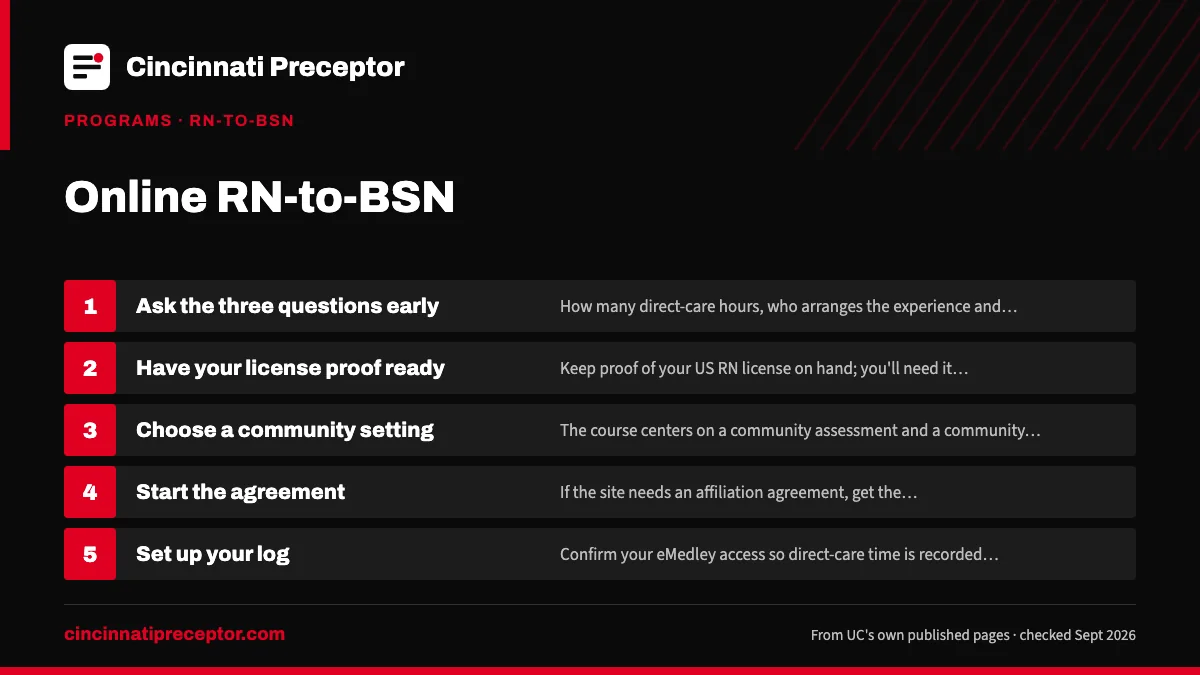
How UC's online RN-to-BSN is set up
UC's RN-to-BSN totals 121 credits, at least 59 of which must transfer in, and its nursing core is nine courses worth 27 credits. The current plan is labeled effective Fall 2026, and UC puts the program at about a year and a half. Core courses include NBSN4065 Nurse as Professional Leader and Manager and NBSN4067 Gerontological Nursing Practice.
Most courses run 7 weeks and are offered twice each semester. Three run the full 14 weeks: statistics, Focus on Community (NBSN4081) and Capstone Experiences (NBSN4068). You can start in spring, summer or fall, with application deadlines of November 15, March 15 and July 15 and classes beginning January 11, May 10 and August 23, 2027.
The program page describes the format as online coursework plus an in-person precepted clinical experience. That in-person piece is the part of the degree this page is about.
The two courses with a clinical piece
UC's public Fall 2026 syllabi give the clearest picture of what the direct-care requirement looks like in practice.
| Course | Length | What the syllabus describes |
|---|---|---|
NBSN4081 Focus on Community (3 credits) | 14 weeks | Direct-care experience secured, or affiliation agreement application submitted, in Module 1; an ongoing direct-care log in eMedley; a community assessment and a community education project |
NBSN4068 Capstone Experiences (3 credits) | 14 weeks | A quality-improvement capstone plan and a professional portfolio; NBSN4062 comes first |
Neither syllabus, nor any UC page we found, gives the number of direct-care hours. You may see a figure quoted elsewhere online; we found no UC source for one, so don't plan around it. The syllabus does name an eMedley direct-care log, so expect to record your time there, and ask your course faculty who verifies the entries. The eMedley page explains the system. Because Focus on Community runs 14 weeks while most courses run 7, the direct-care weeks will likely overlap other coursework, so map the whole semester before you commit to a schedule with a site.
What UC doesn't publish, and who to ask
Several things you need to plan the experience are missing from UC's public pages. UC Online's advisors for online programs are Student Success Coordinators, so start with yours, then your course faculty.
- How many direct-care hours. Not on the program page, the curriculum page or the Fall 2026 syllabi.
- Who arranges the experience. UC describes an in-person precepted experience but doesn't say whether you find the site and preceptor or the college assigns one. UC's graduate students find their own; UC hasn't said the same holds here.
- Who can precept. UC's published preceptor rules cover graduate tracks only.
- Which compliance items apply. Two UC sources disagree on whether you need only a background check or the full set of Critical Requirements.
- How long an agreement takes. UC tells graduate students to allow six weeks or more for its standard affiliation agreement; no RN-to-BSN timeline is published.
UC Online's graduate program pages, such as the FNP page, list a Clinical Site Coordinator among their contacts, but UC names none for the RN-to-BSN, so ask your advisor who handles the paperwork for this one. Put your questions in writing and keep the replies. If your advisor confirms that you arrange the experience yourself, the timeline further down applies.
Don't wait for Module 1 to ask about the direct-care experience. The syllabus expects it secured, or an agreement application in, during the first module, so the answers belong in the term before.
The one UC nursing program open in Arizona and New York
State rules for the RN-to-BSN differ from UC's graduate programs. The College of Nursing's 2026–27 handbook says the RN-to-BSN is its only program allowed in Arizona and New York, two states closed to UC's graduate clinicals. In the other direction, the RN-to-BSN can't accept students from Louisiana, Massachusetts, Oregon, Rhode Island, Tennessee or Washington, and U.S. territories are excluded.
Washington is the surprise on that list: UC's MSN and certificate students can train there, but RN-to-BSN applicants from Washington aren't accepted. If you move during the program, check your new state first; the moving page covers what changes, and the state authorization page sets out the graduate rules for comparison.
Your RN license matters too. Proof of a US RN license is required before either 14-week course, and for graduate clinicals UC wants a license valid in whichever state hosts the clinical. If your direct-care site is across a state line, ask whether the same rule applies to you; the RN license page covers compact licenses.
Getting ready before Focus on Community
If your advisor confirms that you set up the direct-care experience, work backward from the first week of NBSN4081.
- Ask the three questions earlyHow many direct-care hours, who arranges the experience and who may precept. Ask at least a term before
NBSN4081. - Have your license proof readyKeep proof of your US RN license on hand; you'll need it before both 14-week courses.
- Choose a community settingThe course centers on a community assessment and a community education project, so pick a setting where both are realistic.
- Start the agreementIf the site needs an affiliation agreement, get the application moving before the term; the syllabus expects it submitted in Module 1.
- Set up your logConfirm your eMedley access so direct-care time is recorded from the first visit.
How we help: once UC confirms that you arrange the direct-care experience yourself, we search near you for a community site and a nurse willing to precept, favor settings where the community assessment and education project are realistic, and get UC's paperwork ready alongside you. UC approves the site and the experience, and it receives everything it needs to decide.
Questions UC students ask
How many clinical hours does UC's online RN-to-BSN require?
UC doesn't publish a number. The program page describes a direct care requirement with in-person precepted clinical experience, and the Fall 2026 syllabus for NBSN4081 calls for an eMedley direct-care log, but neither gives the hours. Ask your Student Success Coordinator or course faculty, and plan from their answer rather than a figure found elsewhere online.
Can I do the direct-care experience where I work?
UC hasn't published an RN-to-BSN rule on this. On the graduate side, UC generally keeps students from training in the unit that employs them, with exceptions only where a track allows it and the program director signs off. Ask your advisor whether anything similar applies to the RN-to-BSN, and whether a different department in your organization would be acceptable.
Do I need an RN license to start UC's RN-to-BSN?
Not always. UC admits current associate degree nursing students before they are licensed, but you must show proof of US RN licensure before Focus on Community (NBSN4081) and the capstone (NBSN4068). If you already practice as an RN, UC expects your license to be unrestricted.
Does the RN-to-BSN require CastleBranch?
UC's pages conflict. An older, undated College of Nursing page says RN-to-BSN students complete a background check only, while the 2026–27 handbook extends Critical Requirements to every student outside post-baccalaureate certificates and microcredentials. CastleBranch purchases are also on hold for now. Ask your advisor what applies before your first clinical course.
What does the Capstone Experiences course involve?
NBSN4068 runs 14 weeks and, according to its Fall 2026 syllabus, centers on a quality-improvement capstone plan and a professional portfolio. NBSN4062 has to come first, and you'll need your US RN license on file before you enroll. Ask your faculty whether the capstone can build on the setting you used in Focus on Community.
Related pages
Moving during UC clinicalsRelocating during your UC nursing program? Check state authorization, your RN license, CastleBranch and new preceptors before you move, not after.State authorizationUC runs graduate clinicals in all but seven states, keeps Washington closed to DNPs, limits three tracks to OH, KY and IN residents and rules out territories.RN license for clinicalsWhich RN license UC clinicals need: one valid in the clinical state, compact multistate licenses, the patient's state for telehealth, and NCSBN QuickConfirm.eMedley (hours, logs, evaluations)How UC College of Nursing students use eMedley for clinical hours, case logs, portfolio and evaluations, and what preceptors do in eClas and eValuate.UC affiliation agreementHow UC's Educational Affiliation Agreement works: UC's standard form or a site's own contract, the 6-week and 6-month timelines, who handles what, and fees.
Last checked 2026-09-24
We check these pages against UC's own sources. Your Clinical Site Coordinator, your course faculty and UC's current documents have the final word.
Hand us the search. Keep your packet deadline.
Tell us your UC track, where you live and which term your next practicum starts. We look for a preceptor and site that fit UC's rules for your track, and help you get the Preceptor Application and agreement details right.
- Matched to your track's population, setting and hour rules
- Checked against UC's preceptor requirements before your CSC sees it
- Aimed at UC's packet deadline, not just the first day of term
Start your placement plan
A placement advisor replies with what a UC-ready preceptor and site look like for you.