Preceptors for UC's pediatric acute care NP
UC's pediatric acute care NP begins in pediatric primary care and ends in the hospital. In the DNP, ANPC8020 pairs 72 primary care hours with 40 acute care hours, then ANPC8022 and ANPC8024 add 504 more in a pediatric hospital, for 616 in all. Your preceptors can be PNPs, physicians or FNPs with a pediatric focus, and UC says some students in this track may train on the unit where they already work.
Get your UC PNP-AC placement plan
Tell us whether you're in the DNP or the certificate and which practicum is next. A placement advisor replies with pediatric settings that fit UC's rules.
616clinical hours in the DNP
72primary care hours in Practicum I
280hospital hours in Practicum III
How UC's PNP-AC is offered
UC offers pediatric acute care as an online BSN-to-DNP with immersions and as a post-master's certificate. There is no primary care pediatric NP track. Both versions start in fall only. The DNP runs 76 to 79 credits over about three years, prepares you for the PNCB acute care PNP exam, and adds the DNP's 500 practicum hours for your project; see the DNP project practicum.
The certificate is 12 credits over about two years, with the didactic courses ANPC8010 and ANPC8012 and four internships. UC admits only Ohio, Kentucky and Indiana residents to it. The DNP is closed to Washington students, and seven more states are off limits for any UC graduate clinical; state authorization names them.
From Spring 2027, APRN students taking NURS8020C attend a three-day on-campus Advanced Health Assessment immersion in Cincinnati, on top of the program's own immersions. Some UC documents, including the licensure disclosures, still refer to a PNP-AC MSN, but it isn't on UC's current MSN program list. If your paperwork says MSN, confirm your clinical hours with your CSC.
Clinical courses and hours
The DNP moves from community pediatrics into the hospital; the certificate spreads a similar mix over four internships. The full rules are on PNP-AC clinicals.
| Course | Hours | Setting |
|---|---|---|
ANPC8020 Practicum I (DNP) | 112: 72 primary care, 40 acute care | Community pediatric practice or school-based health center, plus a pediatric hospital |
ANPC8022 Practicum II (DNP) | 224 | Pediatric hospital |
ANPC8024 Practicum III (DNP) | 280 | Pediatric hospital |
ANPC8036, ANPC8037, ANPC8038 (certificate) | 140 each | Pediatric hospital for acute care; community practice or school-based center for primary care |
ANPC8039 (certificate) | 140 to 180 | The same settings |
Certificate hours total 560 to 600 depending on the final internship, and your plan of study is set individually after a transcript review. In either version, hours count only within semester dates.
Who can precept a PNP-AC student
UC accepts three kinds of preceptor for this track: a pediatric nurse practitioner, a physician (MD or DO), or a family nurse practitioner whose practice is pediatric-focused. Everything on UC preceptor requirements sits on top of that list; the PNP-AC points to watch are these.
- A pediatric NP's national certification, such as PNCB, has to be current; physicians need pediatric expertise that fits your setting.
- An FNP qualifies only when the practice centers on children, so a general family practice FNP won't be accepted.
- One-fifth or more of your hours with a certified nurse practitioner in your own population focus.
- No relatives as preceptors.
Unusually, UC's preceptor FAQ leaves room for some PNP-AC students to log hours on their own unit. Whether you're one of them is for your CSC and program director to decide; clinicals where you work compares the tracks. Telehealth can count on a case-by-case basis if the program director agrees, but you must be physically on site with the preceptor.
Children's hospitals and how they take NP students
Most PNP-AC hours happen in a pediatric hospital, and those hospitals run their own intake. For NP students, Cincinnati Children's asks for a current Ohio RN license, lists UC among its affiliated schools and takes requests through an APRN Clinical Placement Interest Form. The form typically opens three to four months ahead of the term, answers follow two to three months out, and the hospital says demand outstrips its slots, with its own employees first in line.
UC asks you to go through your Clinical Site Coordinator before contacting Nationwide Children's or Norton. Cincinnati clinical sites covers the local systems in more depth.
Outside Ohio the logic is the same. Hold an RN license for the state you'll train in, as RN license for clinicals explains, and have the hospital's UC agreement signed before your first shift.
Where PNP-AC searches get hard
Two transitions need planning. Practicum I asks for a small, split placement: 72 primary care hours and 40 acute care hours in the same term, which may mean two preceptors at two sites. Practicums II and III then need 504 hospital hours across two terms, with a preceptor who can host you at that volume.
Timing is the other issue. A children's hospital's intake cycle runs on its own clock, separate from UC's packet deadlines, and a hospital that wants its own affiliation agreement instead of UC's standard one can take six months or longer to sign. UC's Clinical Planning and Key Contacts pages also name different coordinators for PNP-AC, so confirm who your CSC is before you send anything.
Hospital onboarding can add its own steps. UC's PNP-AC requirements don't mention PALS or similar certifications, but UC's welcome email can list extra site requirements, so ask each hospital what it expects before your start date.
Check each children's hospital's own application window alongside UC's packet deadline. Cincinnati Children's usually opens its form three to four months before the semester.
Planning the paperwork
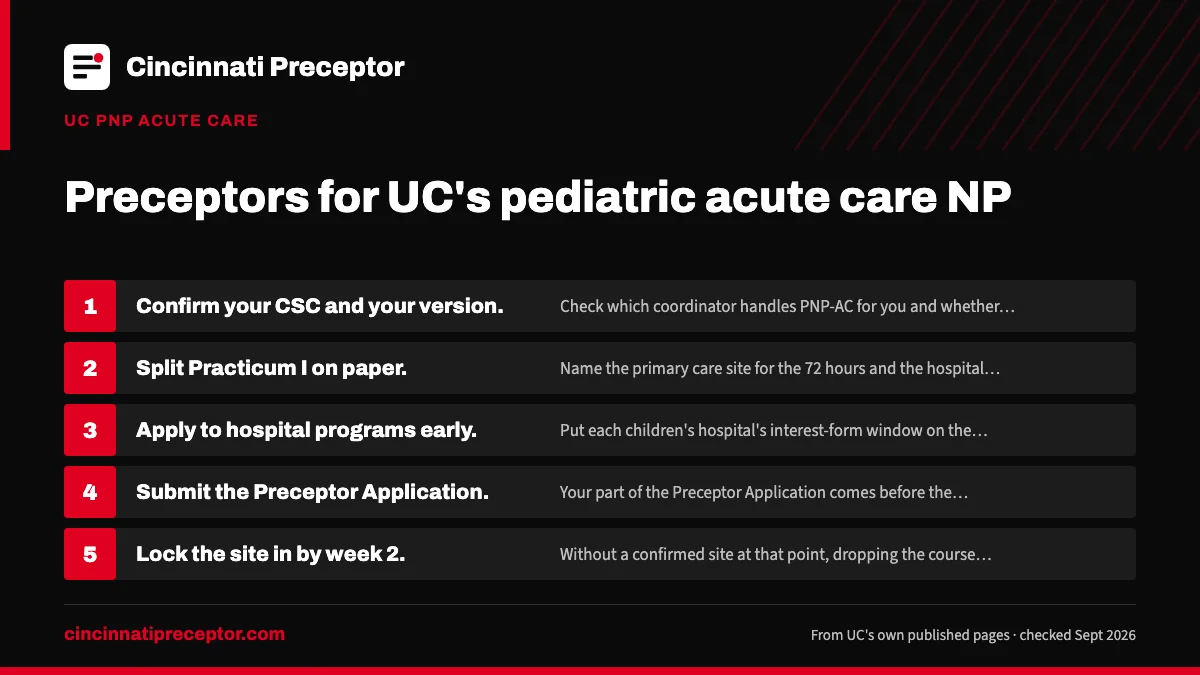
- Confirm your CSC and your version. Check which coordinator handles PNP-AC for you and whether you're following the DNP or certificate hours.
- Split Practicum I on paper. Name the primary care site for the 72 hours and the hospital for the 40, with a preceptor for each.
- Apply to hospital programs early. Put each children's hospital's interest-form window on the same calendar as UC's packet Fridays, listed on packet deadlines. Whichever closes first is your real deadline.
- Submit the Preceptor Application. Your part of the Preceptor Application comes before the preceptor adds theirs and sends it in. Give UC's standard agreement six weeks or more.
- Lock the site in by week 2. Without a confirmed site at that point, dropping the course before the drop date protects your refund; the week-2 rule spells out the risk of staying enrolled.
Where we fit: we look for pediatric primary care and hospital-based preceptors near you who meet UC's PNP-AC rules, help you assemble what the paperwork asks for, and help you regroup if a preceptor drops. The final yes on any preceptor or unit comes from UC, not from us. See how it works.
Questions UC students ask
Does UC have a primary care pediatric NP program?
No. UC's pediatric NP offering is pediatric acute care, as a DNP and a post-master's certificate. Primary care still appears in it: the DNP's first practicum, ANPC8020, includes 72 hours in a community pediatric office or school-based clinic before the hospital-based practicums begin.
Can an FNP precept a UC PNP-AC student?
Yes, if the FNP's practice is pediatric-focused. UC's PNP-AC requirements list pediatric nurse practitioners, MDs or DOs, and pediatric-focused FNPs. Whoever precepts you still has to clear UC's general bar on certification, experience and licensure.
Can I do PNP-AC clinical hours on my own unit?
Possibly. UC's preceptor FAQ carves out room for some PNP-AC students to log clinical time on the unit that employs them, an exception among UC's NP tracks. It's a program decision, so put the question to your Clinical Site Coordinator and program director before you build a plan on it.
Does Cincinnati Children's require an Ohio RN license?
For its NP clinical practicum, yes. Cincinnati Children's asks for an active Ohio RN license, attendance at an affiliated program such as UC, and an APRN Clinical Placement Interest Form. Separately, UC requires an RN license valid in whichever state you complete your clinical hours.
Is the PNP-AC certificate open to students in any state?
No. UC's post-master's PNP-AC certificate page limits admission to residents of Ohio, Kentucky and Indiana. The DNP is open more widely but excludes Washington along with the seven states where UC places no graduate clinicals. Both versions start in fall only.
Related pages
PNP-AC clinicals: ANPC8020 to ANPC8024UC's pediatric acute care NP DNP has 616 clinical hours in ANPC8020, ANPC8022 and ANPC8024, opening with primary care. Certificate hours and preceptors too.Cincinnati health systems and NP studentsHow UC Health, TriHealth, Christ Hospital, Mercy Health, St. Elizabeth and Cincinnati Children's take NP students, per their own pages. UC approves each site.Clinicals at your employerCan you do UC clinicals at your employer? AGPCNP students can't, FNP students can outside their own department, and midwifery needs a signed workplace plan.Post-master's NP certificatesUC's post-master's NP certificates: individualized FNP internships, OH/KY/IN residency for AGPCNP, AGACNP and PNP-AC, and the PMHNP virtual intensive.BSN-to-DNP NP tracksUC's BSN-to-DNP NP tracks pair the specialty clinicals with 500 DNP practicum hours, start in fall only and run three years. How to plan the preceptor search.DNP project practicum: 500 hoursUC's DNP project runs through NDNP9025, NDNP9035 and NDNP9038, 500 practicum hours in all. The project site, team and defense, and what UC leaves open.
Last checked 2026-09-24
We check these pages against UC's own sources. Your Clinical Site Coordinator, your course faculty and UC's current documents have the final word.
Hand us the search. Keep your packet deadline.
Tell us your UC track, where you live and which term your next practicum starts. We look for a preceptor and site that fit UC's rules for your track, and help you get the Preceptor Application and agreement details right.
- Matched to your track's population, setting and hour rules
- Checked against UC's preceptor requirements before your CSC sees it
- Aimed at UC's packet deadline, not just the first day of term
Start your placement plan
A placement advisor replies with what a UC-ready preceptor and site look like for you.