Preceptors for UC's online nurse-midwifery MSN
UC's nurse-midwifery MSN needs 784 clinical hours over four courses, from gynecologic and primary care in ANW8006 to full-scope midwifery in ANW8064. At least half of those hours must be with a certified nurse-midwife or certified midwife, and your 35 or more births have to happen in a hospital or a hospital-attached birth center. The intrapartum placement for ANW8062 is the one to start chasing first.
Get your UC midwifery placement plan
Tell us your state and which midwifery practicum is next. A placement advisor replies with CNM and birth-site options that fit UC's rules.
784clinical hours
35births at minimum
50%of hours with a CNM or CM
42lab hours on top
How UC's midwifery MSN is built
The nurse-midwifery program is an online MSN, accredited by ACME, with in-person precepted clinicals and time on campus. UC Online lists 57 credits, 784 clinical hours and 42 lab hours; the curriculum guide lays that out as a two-year, six-semester plan, and new cohorts begin in spring, summer and fall. Admission requires prior experience caring for women in the antepartum, intrapartum or postpartum period, and labor and delivery experience is preferred.
Midwifery carries two skills events of its own. CSI 1 is an online day that opens your ANW8006 semester, and CSI 2 brings you to campus for two days as ANW8062 begins, rehearsing birth and GYN skills such as shoulder dystocia and postpartum hemorrhage scenarios. The NURS8020C health assessment immersion comes on top from Spring 2027; the immersion page has the logistics.
Seven states are closed to UC's graduate clinicals, midwifery included; state authorization names them and the extra forms a few others require.
The four clinical courses
Hours rise from 168 to 224 once births begin. Full course rules and experience targets are on midwifery clinicals.
| Course | Hours | Focus and setting |
|---|---|---|
ANW8006 | 168 | Gynecologic, reproductive and sexual health, primary care and preconception care in CNM or OB/GYN practices, hospital clinics, health departments, FQHCs or family planning clinics |
ANW8060 Practicum I | 168 | Outpatient antepartum and gynecologic care, contraception and STIs |
ANW8062 Practicum II | 224 | Intrapartum, birth, postpartum and newborn care to 28 days, in a hospital or hospital-attached birth center |
ANW8064 Practicum III | 224 | Full-scope midwifery care, plus practice management and regulation |
UC's minimum experiences are 40 primary care, 80 gynecologic, 100 antepartum, 60 intrapartum (with at least 35 births), 50 postpartum and 30 newborn. UC notes that most students log many more. Home births are limited to two weeks or five births.
Who can precept a midwifery student
Midwifery breaks from UC's NP rules in several ways. Once a preceptor clears the general bar on UC preceptor requirements, these track rules decide the rest.
- At least 50% of your clinical hours with a CNM or CM, certified through AMCB.
- Other preceptors by course: OB/GYN physicians, family practice physicians (in
ANW8062, only those who attend births) and nurse practitioners inANW8006. - Licensed midwives (LM) and certified professional midwives (CPM) cannot precept.
- No minimum hours per preceptor, but anyone you work with for 8 hours or more must submit a full Preceptor Application, and every midwifery preceptor also sends a CV.
- A physician assistant may supervise at most 20 hours, only in
ANW8006, only in the states UC allows and only with program director approval. - Relatives can't precept you, and someone from your own department needs the program director's approval.
Your workplace, telehealth and certifications
Midwifery students may train where they work, which several UC NP tracks restrict. The arrangement is written up on a form titled “Precepting in the Setting Where You Work”, approved by the program director and signed by the two of you. Clinicals where you work compares this with the other tracks.
Telehealth may count here too, one request at a time and only with the program director's agreement. Midwifery is one of two tracks where you can join those visits from elsewhere by live video, never from a public place, and your RN license has to match the state the patient is sitting in.
Before ANW8062 you must complete a fetal monitoring course and hold Neonatal Resuscitation Program (NRP) certification. Build both into the term before Practicum II so neither holds up the start of your birth placement, which also opens with the on-campus intensive in week 1.
Where midwifery searches get hard
The intrapartum placement is the bottleneck. ANW8062 needs a CNM or physician who attends births at a hospital or a hospital-attached birth center, enough birth volume to move you toward 35, and a site whose agreement can be signed in time. A freestanding birth center that isn't attached to a hospital doesn't meet UC's setting rule for births.
The 50% rule shapes the rest of the plan. An OB/GYN practice may give you excellent gynecologic and antepartum hours, but you still need enough CNM or CM time elsewhere to keep your total at half. Track the split every term rather than discovering a shortfall during ANW8064.
The 8-hour application rule adds paperwork in group practices. If several midwives share call at your birth site, each one you work alongside for 8 hours or more needs an application and CV on file, so ask early who is likely to be on duty during your term.
UC requires births in a hospital or hospital-attached birth center and caps home births at two weeks or five births. Don't build your birth plan around a home birth practice.
Timing your midwifery packets
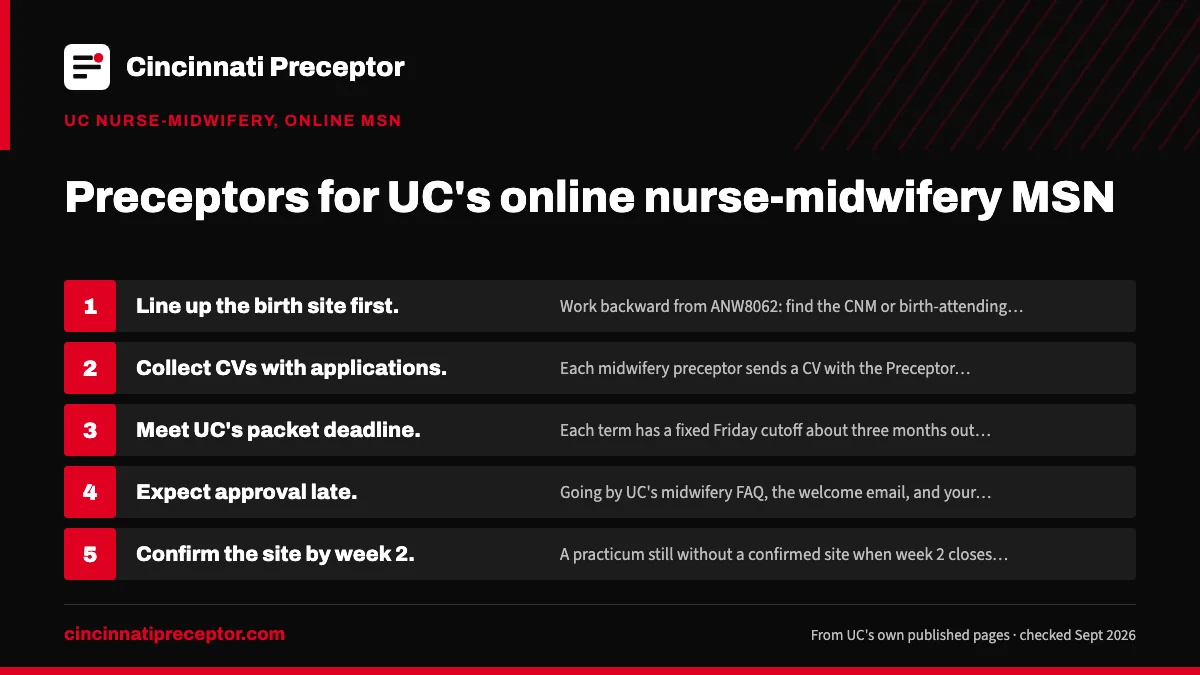
- Line up the birth site first. Work backward from
ANW8062: find the CNM or birth-attending physician, confirm the hospital or attached birth center, and check when NRP and fetal monitoring fit. - Collect CVs with applications. Each midwifery preceptor sends a CV with the Preceptor Application, after you finish the student section.
- Meet UC's packet deadline. Each term has a fixed Friday cutoff about three months out; packet deadlines lists them. Large systems such as Cleveland Clinic must be approached through your CSC first, so start those earlier.
- Expect approval late. Going by UC's midwifery FAQ, the welcome email, and your preceptor's appearance in eMedley, tend to come only three to six weeks ahead of classes. The site agreement runs on its own clock of six weeks or more.
- Confirm the site by week 2. A practicum still without a confirmed site when week 2 closes should be dropped before the drop date to protect your refund. The week-2 rule has the detail.
Where we fit: we search for CNMs, birth-attending physicians and gynecologic preceptors near you who meet UC's midwifery rules, help you assemble application details and CVs, and stay involved if a preceptor pulls out. Your coordinator and program director still decide who is approved. Read how it works for our steps.
Questions UC students ask
How many births does UC's midwifery program require?
At least 35 births, counted within at least 60 intrapartum experiences, and UC says most students log more. Births must take place in a hospital or a hospital-attached birth center. Home births are capped at two weeks or five births, so plan your birth numbers around a hospital-based preceptor.
Can an OB/GYN physician precept UC midwifery students?
Yes. OB/GYN physicians are on UC's list for the midwifery courses, as are family practice physicians, who must attend births to precept intrapartum care. But a CNM or CM has to supervise at least half of your 784 hours, so physician hours have to be balanced by midwife hours across the program.
Does a midwifery preceptor need to send a CV to UC?
Yes. For most UC programs a fully completed Preceptor Application makes the CV optional, but midwifery is the exception, because accreditation calls for it. Anyone who precepts you for 8 hours or more needs the full application, so gather CVs early rather than chasing them at the packet deadline.
Can I do midwifery clinicals at the hospital where I work?
Yes, with conditions. UC lets midwifery students train at their workplace once the program director approves the plan and it's written up on UC's “Precepting in the Setting Where You Work” form, which you both sign. A same-department preceptor needs the director's approval as well.
When do UC midwifery students need NRP?
Before ANW8062, Nurse-Midwifery Practicum II. UC wants a fetal monitoring course finished and NRP certification in hand before that practicum begins. It's also the term that opens with the two-day on-campus Clinical Skills Intensive 2 in week 1.
Related pages
Nurse-midwifery clinicals and hoursUC's nurse-midwifery clinicals, ANW8006 to ANW8064, carry 784 hours plus minimum births and visits. CNM supervision, NRP timing and birth-setting rules.UC Preceptor ApplicationHow UC's Preceptor Application works: your student section first, what the preceptor fills in, when a CV is required, and which address the packet goes to.Clinicals at your employerCan you do UC clinicals at your employer? AGPCNP students can't, FNP students can outside their own department, and midwifery needs a signed workplace plan.NURS8020C immersion and intensivesFrom Spring 2027, UC's NURS8020C health assessment course adds three days on campus. The dates, what happens, and the midwifery, WHNP and PMHNP intensives.UC preceptor requirementsUC's preceptor rules: master's or higher, accepted certification, a year in the role, a clean license in the clinical state, and the 20% NP and 50% CNM rules.WHNP (online MSN)Finding preceptors for UC's online WHNP: WHNPs, CNMs and OB/GYN clinicians across four 168-hour practicums, gynecologic then obstetric, on UC's deadlines.
Last checked 2026-09-24
We check these pages against UC's own sources. Your Clinical Site Coordinator, your course faculty and UC's current documents have the final word.
Hand us the search. Keep your packet deadline.
Tell us your UC track, where you live and which term your next practicum starts. We look for a preceptor and site that fit UC's rules for your track, and help you get the Preceptor Application and agreement details right.
- Matched to your track's population, setting and hour rules
- Checked against UC's preceptor requirements before your CSC sees it
- Aimed at UC's packet deadline, not just the first day of term
Start your placement plan
A placement advisor replies with what a UC-ready preceptor and site look like for you.