Precepting a University of Cincinnati nursing student
If a UC College of Nursing student has asked you to precept, saying yes means a short application, an agreement between UC and your organization, one to two clinical days a week, time-log checks in eMedley and two evaluations a term. UC's Clinical Site Coordination team vets you and your site before the student's first day.
Open to hosting UC students?
Tell us your specialty, license state and the days you could offer. A placement advisor replies.
1–2days a week UC asks preceptors to host a student
14 dayshow often UC asks you to verify time logs
2evaluations a term: a midterm and a final
Who UC accepts as a preceptor
UC's May 2026 Clinical Preceptor Guide sets the baseline. You need a master's degree or higher, national certification in your field and at least a year in the role, plus an active license without encumbrances in the state where the clinical takes place. A license with past discipline is reviewed case by case. For nurse practitioners the certifying bodies are ANCC, AANPCB, PNCB and AACN; UC also names NCC for women's health NPs and AMCB for nurse-midwives, and physicians (MD or DO) with relevant expertise can precept.
Tracks narrow this further. FNP students can't train with a clinical nurse specialist or a CPM, LM or CM, and midwifery students can't use LM or CPM holders. A PMHNP student's first internship needs a master's-level licensed therapist, for example an LCSW, a licensed counselor or a psychologist, before moving on to prescribers. PAs are accepted only in a short list of states, case by case, you can't precept a relative, and most tracks bar a student's own supervisor. Where a state board sets stricter preceptor rules, UC says those win. The preceptor requirements page has every track's list.
The application and the site agreement
UC's Preceptor Application has two halves. The student completes theirs first; you then add your license states, certifying body, years in practice, graduate education or a CV, the clinical site's details, the name of the site's administrative contact for agreements, and whether an agreement with UC is already active. Nurse-midwifery preceptors must attach a CV. You email the finished packet to the address the student's Clinical Site Coordinator gives, because UC's documents list more than one.
UC won't allow any clinical activity until an Educational Affiliation Agreement is in effect. The coordinator usually sends UC's standard agreement, already approved by UC's Office of General Counsel, to your site's administrative contact. If your organization insists on its own contract, both legal teams negotiate, which UC says can take six months or longer; even the standard route usually takes at least six weeks. UC can send your site a Letter of Good Standing, proof of the student's liability and malpractice coverage, and a compliance summary, and students are covered by UC's self-insurance and commercial insurance while enrolled. The affiliation agreement page goes deeper.
What a term with a UC student looks like
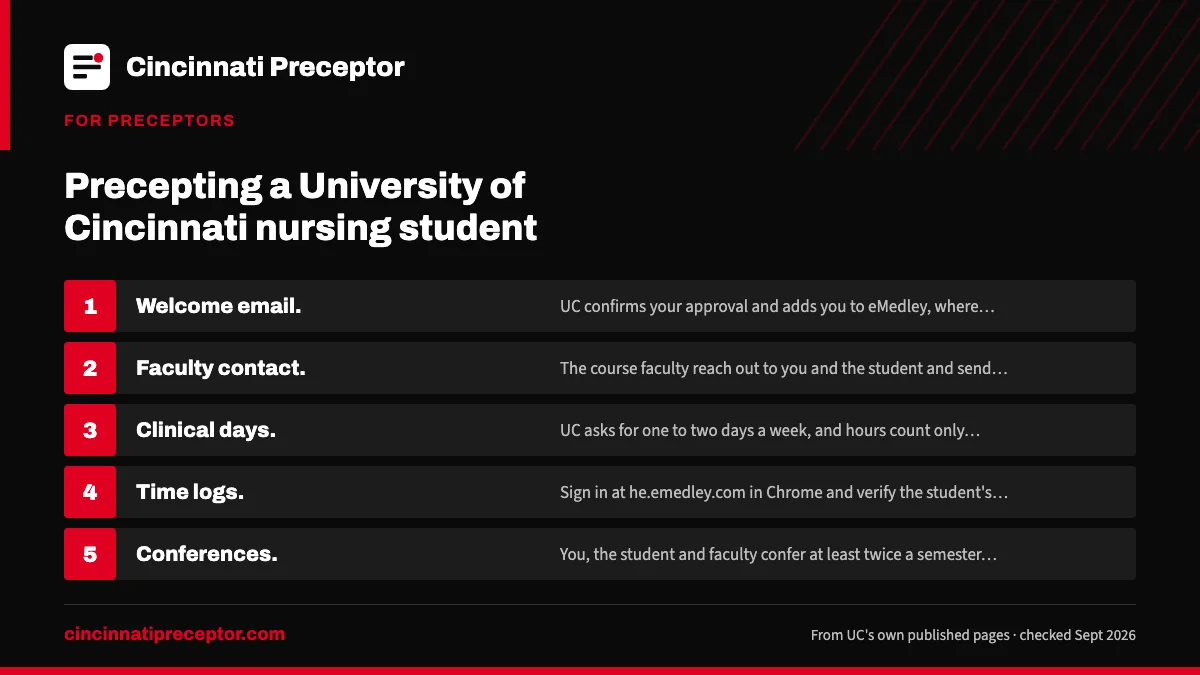
- Welcome email. UC confirms your approval and adds you to eMedley, where access is limited to preceptors with a submitted application.
- Faculty contact. The course faculty reach out to you and the student and send the syllabus and an introduction letter.
- Clinical days. UC asks for one to two days a week, and hours count only inside the semester's official dates, the window in which the student's malpractice coverage applies.
- Time logs. Sign in at he.emedley.com in Chrome and verify the student's time logs in eClas about every 14 days. You don't sign off case logs.
- Conferences. You, the student and faculty confer at least twice a semester. The student schedules these.
- Evaluations. The student sends you a midterm and a final evaluation to complete in eValuate. Faculty assign the grade using your feedback, and no grade is given until all evaluations and hours are in.
If something goes wrong during a clinical day, the student reports it to course faculty within 24 hours. The eMedley page shows what you'll see when you sign in.
What UC offers preceptors
UC is direct about pay: its preceptor FAQ states that the college does not currently compensate preceptors financially. What it does offer is continuing education webinars through the academic year, listed through the UC Alumni Association.
UC's preceptor training page also points to outside development resources, including the HRSA/ANEW online modules, NONPF video vignettes and the Ohio Primary Care Workforce Initiative's preceptor development series. The preceptor landing page links short teaching guides on the One-Minute Preceptor and SNAPPS models, which suit a busy clinic day.
Each year UC's APRN Preceptor Awards recognize one preceptor from the Ohio, Kentucky and Indiana tri-state region and one from outside it, each with a plaque and a cash award, and an Organization Award honors clinical sites. As a preceptor you're also expected to follow FERPA and HIPAA in how you handle the student's information.
Questions to settle before you say yes
- Will your organization sign UC's standard agreement, or does it require its own? Who is the administrative contact?
- Does your site charge an administrative fee? UC notes each site sets its own, and some agreements have UC collect it from the student.
- What onboarding system does your site run students through (ACEMAPP, MyClinicalExchange or another), and how long does it take?
- Is your system one UC coordinates centrally? UC asks students to contact their CSC before approaching Cleveland Clinic, Nationwide Children's, The Little Clinic, Summa Health, Norton, Allina, Essentia or Stanford Health Care.
- How many of the course's hours can you cover? A first FNP practicum,
ANNP8070, totals 168 hours, which the student may split between preceptors. - Is the student your employee, direct report or relative? Each can rule the placement out.
Where we come in
UC students come to our placement service to find their preceptors, and if one reached you that way, we make your paperwork simple. We walk you through the preceptor half of the application, gather the site details UC's coordinators ask for, including the administrative contact for the agreement, and check that the packet is complete before it goes in. UC's Clinical Site Coordination team then reviews you directly and gives the final approval.
If you'd be open to hosting UC nursing students in future, use the form on this page; it's already set to the preceptor option. Tell us your specialty, license state, practice setting and which days each week you could offer a student. For how the student side of the search works, see how it works.
Questions UC students ask
Will I be paid for precepting a UC student?
Not by UC, which says plainly that it doesn't currently pay preceptors, and a site's administrative fee, where one exists, goes to the site rather than to you. UC's recognition comes through continuing education webinars and its annual preceptor awards.
Can I precept a student in a state where I'm not licensed?
No. UC requires your license to be active and unencumbered in the clinical state, and the student needs a valid RN license there too. A clinical in California, North Dakota or Wyoming also triggers additional state paperwork, which goes to UC's state authorization mailbox separately from the packet.
Can I share a UC student with a colleague?
Often, within limits. AGPCNP students can have no more than two preceptors a semester and one in Practicum I unless faculty approve, and PMHNP students at most two a semester. In midwifery, any clinician who spends eight or more hours with a student needs a full application. Check the student's track rules first.
What do I do if I can't sign in to eMedley?
Make sure you're using Chrome at he.emedley.com, and that your Preceptor Application has been submitted, because only preceptors with an application on file can log in. For duplicate accounts or merge problems, UC's eMedley support address is conemedley@uc.edu. The student's CSC can also confirm your approval went through.
Does precepting earn me continuing education credit?
UC offers CE webinars during the year, and its training page lists outside modules and development series. UC's published pages don't mention contact hours for the precepting itself, so if you need credit for a license renewal, check your own board's rules on precepting.
Related pages
UC preceptor requirementsUC's preceptor rules: master's or higher, accepted certification, a year in the role, a clean license in the clinical state, and the 20% NP and 50% CNM rules.UC Preceptor ApplicationHow UC's Preceptor Application works: your student section first, what the preceptor fills in, when a CV is required, and which address the packet goes to.UC affiliation agreementHow UC's Educational Affiliation Agreement works: UC's standard form or a site's own contract, the 6-week and 6-month timelines, who handles what, and fees.eMedley (hours, logs, evaluations)How UC College of Nursing students use eMedley for clinical hours, case logs, portfolio and evaluations, and what preceptors do in eClas and eValuate.Preceptor evaluations and conferencesHow UC's midterm and final preceptor evaluations work in eMedley, who books the twice-a-term faculty conference, and what the practicum journal involves.How it worksOur preceptor search for UC nursing students in UC's own order: your track and term, the search, the Preceptor Application, the agreement, your hours.
Last checked 2026-09-24
We check these pages against UC's own sources. Your Clinical Site Coordinator, your course faculty and UC's current documents have the final word.
Hand us the search. Keep your packet deadline.
Tell us your UC track, where you live and which term your next practicum starts. We look for a preceptor and site that fit UC's rules for your track, and help you get the Preceptor Application and agreement details right.
- Matched to your track's population, setting and hour rules
- Checked against UC's preceptor requirements before your CSC sees it
- Aimed at UC's packet deadline, not just the first day of term
Start your placement plan
A placement advisor replies with what a UC-ready preceptor and site look like for you.