The UC Preceptor Application: your section, theirs, and where it goes
UC vets every preceptor through the Preceptor Application, last revised in October 2025. You complete the student section first, your preceptor adds their license, certification, experience and site details, and then the preceptor emails the finished packet to UC. A CV is optional on most tracks if the form is complete, but nurse-midwifery preceptors must attach one.
Get your UC placement plan
Your UC track and where you live. A placement advisor replies with what a UC-ready preceptor and site look like for you.
Oct 2025revision date of the current Preceptor Application
8 hrswith any midwifery preceptor before a full application is due
What the application does
The Preceptor Application is how UC's Clinical Site Coordination team vets a preceptor. No clinician is approved without one, and UC's eMedley page adds that a preceptor without an application on file can't log in to verify your hours or complete your evaluations.
The current form is dated October 10, 2025 and is linked from UC's Clinical Planning page. Older copies get passed around, so download a fresh one from UC instead of reusing a file a classmate sent.
The form also feeds the next stage. The site details and administrative contact your preceptor enters are what your CSC uses to send the Educational Affiliation Agreement, so a blank here holds up the agreement as well as the approval. It records your own RN license details too, and those need to cover the state where you'll train.
Your section comes first
UC's instructions put the student section ahead of the preceptor's. It asks for:
- your RN license and the state that issued it
- whether that license is a compact (multistate) license
- whether you work for the organization where you'll train
- where you stand with CastleBranch
- which terms you plan to use this preceptor
Take care with the employment question. It's how UC applies the employer rules for your track, which range from a flat no on AGPCNP to an allowed arrangement with a signed plan in midwifery. Your license answer should cover the state where you'll train, not only the one you live in; the RN license page explains why that matters. If your Critical Requirements aren't finished yet, say so plainly in the CastleBranch field instead of leaving it blank.
What your preceptor fills in
The preceptor's half is mostly credentials and site logistics. Expect these fields:
- license or licenses, listed by state
- the certification body
- years in the field
- graduate education, or a CV in its place
- details of the clinical site
- the site's administrative contact for agreements
- whether an agreement with UC is already active
If your preceptor isn't sure who handles contracts for the practice, ask them to find out before they start the form. The same goes for the agreement question. An honest "not sure" is acceptable, but a quick check with the practice manager can spare your CSC a round of emails and tells you early whether a new agreement is coming. Ask your preceptor to list every state license they hold, not just the one for your clinical state.
When UC wants a CV
On most tracks a CV or resume is optional, provided every field on the form is complete. Nurse-midwifery is the exception: UC requires a CV from midwifery preceptors for accreditation.
Midwifery carries a second rule that is easy to miss. Every preceptor who supervises you for 8 hours or more has to send a full application, CV included, even if they cover only a few shifts. In a practice that rotates you among several midwives or physicians, each one who reaches that threshold needs a packet of their own.
On other tracks, attaching a CV can still be worthwhile when the education field is thin or the preceptor holds an unusual mix of credentials, since it answers the CSC's questions up front.
Sending the packet
The handoff runs in a fixed order, and one step (state forms) is easy to put in the wrong place.
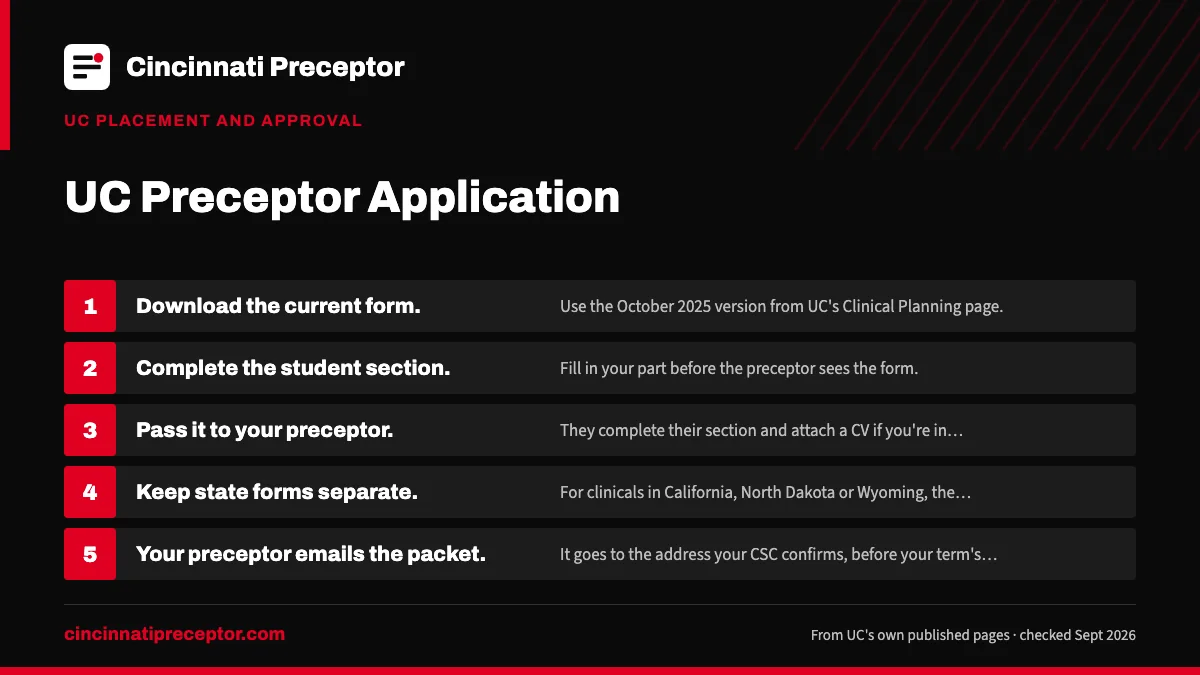
- Download the current form. Use the October 2025 version from UC's Clinical Planning page.
- Complete the student section. Fill in your part before the preceptor sees the form.
- Pass it to your preceptor. They complete their section and attach a CV if you're in nurse-midwifery or their education entry needs one.
- Keep state forms separate. For clinicals in California, North Dakota or Wyoming, the state forms go on their own to constateauth@uc.edu no later than one week before the semester starts; see state forms.
- Your preceptor emails the packet. It goes to the address your CSC confirms, before your term's packet deadline.
- Confirm it arrived. The FNP FAQ tells FNP students how to check that UC received the application; on other tracks, ask your CSC.
UC's documents disagree on the address. The application form names conpreceptor@uc.edu, while the May 2026 Clinical Planning Checklist says to send it to your CSC or to conprptr@ucmail.uc.edu. Ask your CSC which to use and have your preceptor send it there.
Don't guess at the destination. Two UC documents name different mailboxes for the packet, so get the address from your CSC in writing before your preceptor sends it.
After it's sent
The College of Nursing vets the preceptor, and approval shows up as a welcome email plus the preceptor's appearance in eMedley. The nurse-midwifery FAQ puts that at roughly three to six weeks before the term, and the FNP FAQ says four to six, so ask your CSC which window applies to you.
Read the welcome email to the end. It can list extra requirements the site has, and those lead straight into your site onboarding. If UC turns the preceptor down, the preceptor not approved page goes through why that happens and how to respond.
This is where our help is most practical. Before the form is started, we help you pull together your preceptor's credentials, the name of whoever handles contracts at the site, and the platform the site uses for onboarding, so the packet goes in whole. UC still reviews and approves it. Ask us about your track.
Questions UC students ask
Does my UC preceptor need a new application every term?
The student section asks which terms you plan to use the preceptor, so one application can name more than one term. UC doesn't publish a rule on resubmitting, though. If you add a term later, move to a different site or change tracks, ask your CSC whether a fresh application is needed rather than assuming the old one carries over.
Who sends the Preceptor Application to UC, me or my preceptor?
Your preceptor. You complete the student section first and hand the form over; the preceptor fills in their part and emails the whole packet to UC. Keep a copy of what you gave them and ask to be copied on their email, so you can tell your CSC exactly when it went in.
Do I need an application for every preceptor I work with?
Yes, each preceptor completes their own. That adds up on tracks with several: FNP needs at least three preceptors over the program, AGPCNP and PMHNP allow up to two a semester, and in nurse-midwifery anyone you spend 8 or more hours with must submit a full application with a CV.
What happens if my preceptor's form has gaps?
UC treats a CV as optional only when the form is fully completed, which shows how much the review leans on every field. Gaps mean follow-up questions, and because coordinators handle files in the order received, a returned form can land behind others. Read it over with your preceptor before it is sent.
Is the Preceptor Application the same as the affiliation agreement?
No. The application vets the person, while the Educational Affiliation Agreement is a contract between UC and the site. The application does collect the site's administrative contact and whether an agreement is already active, which is how your CSC knows whether to send one and to whom.
Related pages
UC preceptor packet deadlinesUC's preceptor packet deadlines: last Friday in May (fall), first Friday in October (spring), first Friday in February (summer), and what a late packet risks.UC preceptor requirementsUC's preceptor rules: master's or higher, accepted certification, a year in the role, a clean license in the clinical state, and the 20% NP and 50% CNM rules.UC affiliation agreementHow UC's Educational Affiliation Agreement works: UC's standard form or a site's own contract, the 6-week and 6-month timelines, who handles what, and fees.eMedley (hours, logs, evaluations)How UC College of Nursing students use eMedley for clinical hours, case logs, portfolio and evaluations, and what preceptors do in eClas and eValuate.Preceptor not approvedUC turned down your preceptor or site. The rules that most often sink a UC approval, track by track, and how to repair or replace before the next deadline.Preceptor outreachHow to approach a preceptor for your UC clinical: UC's own outreach scripts and tips, the interview questions UC suggests, and what to send after a yes.
Last checked 2026-09-24
We check these pages against UC's own sources. Your Clinical Site Coordinator, your course faculty and UC's current documents have the final word.
Hand us the search. Keep your packet deadline.
Tell us your UC track, where you live and which term your next practicum starts. We look for a preceptor and site that fit UC's rules for your track, and help you get the Preceptor Application and agreement details right.
- Matched to your track's population, setting and hour rules
- Checked against UC's preceptor requirements before your CSC sees it
- Aimed at UC's packet deadline, not just the first day of term
Start your placement plan
A placement advisor replies with what a UC-ready preceptor and site look like for you.