Asking a preceptor to take you on as a UC student
Start with the outreach kit UC already gives you on its Clinical Planning page: email and phone scripts, networking tips and a clinical planning checklist. Know your track's hours and preceptor rules before you ask, test the fit with UC's own interview questions, and once a clinician says yes, complete your section of the Preceptor Application so they can finish theirs.
Get your UC placement plan
Your UC track and where you live. A placement advisor replies with what a UC-ready preceptor and site look like for you.
1-2days a week UC asks preceptors to host a student
14days between a preceptor's time-log checks in eMedley
2preceptor evaluations a term: midterm and final
Start with UC's own outreach kit
UC doesn't leave outreach to guesswork. Its graduate Clinical Planning page tells newly admitted students to review a set of resources before contacting anyone, and several are built for exactly this step.
- Your program's clinical requirements document, for preceptor types, hours and settings.
- The clinical planning glossary, so you use UC's terms correctly with a busy clinician.
- The Clinical Planning Checklist.
- Networking Tips, including the questions UC suggests for a prospective preceptor.
- Academic Netiquette, for tone and email conduct.
- Email and phone outreach scripts.
- The Clinical Course Expectations document and UC's YouTube playlist.
UC wants you building contacts with nearby healthcare organizations from semester one, long before a practicum is on your schedule. Tailor UC's scripts with your track, course and term dates so each request reads as specific rather than generic.
Know your ask before you call
A preceptor's first question is usually how much time you need. Have the answer ready: your track, the course number, the hours for that course, the semester dates and roughly how many days a week you'd come. UC's preceptor FAQ asks preceptors to host students one to two days a week.
Check your track's per-preceptor rules as well. An FNP preceptor has to give you 60 hours or more, and you need three different ones over the program; AGPCNP and AGACNP set the per-preceptor floor at 80 hours, and PMHNP at 40. AGPCNP students also need at least four hours a day, in outpatient settings only. Asking an AGPCNP preceptor for 30 hours sets up an approval problem.
Then measure the clinician against UC's preceptor requirements, which cover graduate education, board certification, time in practice and a clean license where you'd train. Hours per course are on UC clinical hours.
Where to look, and who to clear with your CSC first
Your own network comes first: colleagues, former classmates, clinicians you've worked beside and practices near you. UC also suggests the ANCC's Preceptor Connect group on Facebook as an extra channel, and if the search stalls, your CSC has names of past UC preceptors and alumni living in your state. UC placement help covers what else the CSC can offer.
Some systems aren't for cold outreach. UC names eight systems, among them Cleveland Clinic, Norton and Summa Health, where you must check with your CSC before pursuing a preceptor; site onboarding has the whole list. Send nothing to a clinician at those systems until your CSC says how to proceed.
Large Cincinnati-area systems run their own student processes. Cincinnati Children's, for example, uses an APRN Clinical Placement Interest Form and asks for an active Ohio RN license. Cincinnati clinical sites covers the local systems one by one.
The questions UC suggests you ask
UC's networking suggestions give students a list of interview questions for prospective preceptors. Ask them in the first real conversation, before either of you spends time on paperwork.
- How many hours a week can you precept, and on which days?
- What is your patient volume, and what kinds of patients would I see?
- Does your site need an affiliation agreement with UC, or does it already have one?
- Which onboarding platform does your site use, such as ACEMAPP or MyClinicalExchange?
- Do you or your site charge a fee to precept, and what are the refund terms?
UC's networking document is dated 2022, and one line in it is out of date: it says UC doesn't require an affiliation agreement. UC's current Clinical Planning page says an agreement is required for every clinical rotation and must be in place before you start. Ask the agreement question as "who signs for the site," not "do we need one."
What to tell a preceptor about UC's expectations
Clinicians say yes more easily when they know the workload. Be plain about what UC expects: hosting you one to two days a week, verifying your time logs in eMedley every 14 days, completing a midterm and a final evaluation, and conferring with your faculty and you at least twice a semester. You schedule those meetings, not the preceptor.
Tell them what UC provides too. Faculty send the syllabus and an introduction letter. Your CSC handles the agreement and can send the site a Letter of Good Standing and verification of your malpractice coverage, which UC carries from enrollment. Preceptors don't sign off case logs in eMedley.
Be honest about compensation. UC doesn't pay preceptors; it offers continuing-education webinars through the year and recognizes preceptors with annual APRN Preceptor Awards, one for the tri-state region and one outside it. Precepting UC students is the page to share with a clinician who wants detail.
After a yes: what to send, and in what order
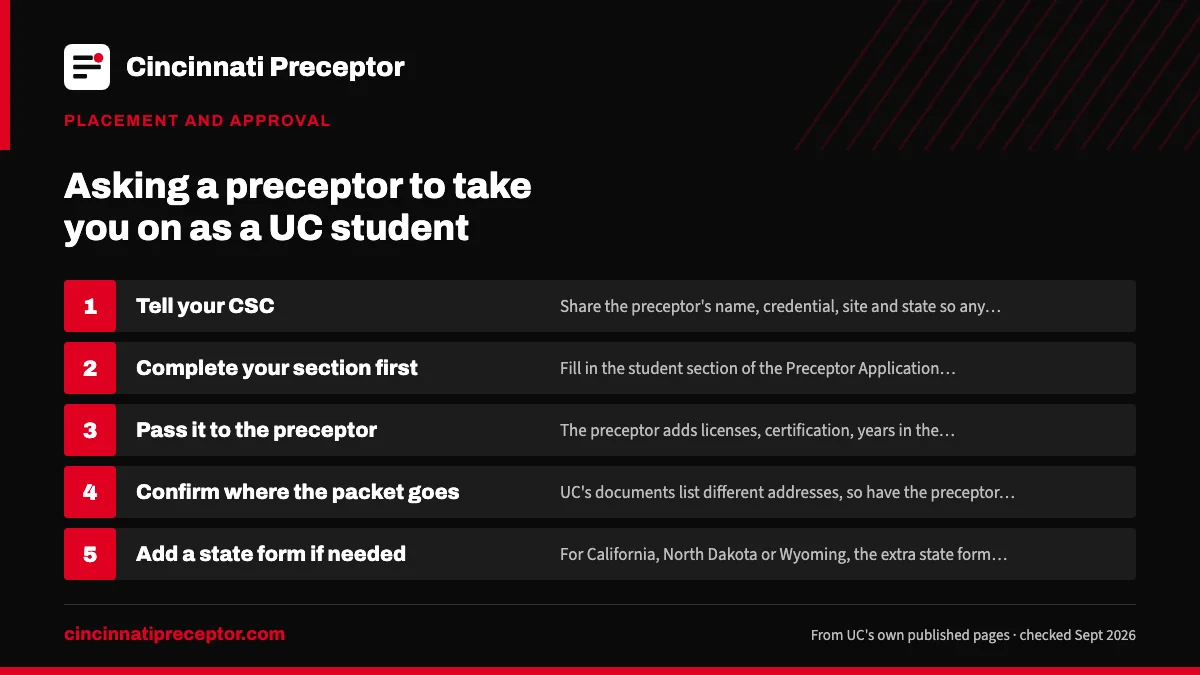
- Tell your CSCShare the preceptor's name, credential, site and state so any system-specific rule surfaces early.
- Complete your section firstFill in the student section of the Preceptor Application (revised October 2025): your RN license and state, whether it's a compact license, whether you work for the organization, your CastleBranch status and the terms you plan to train with this preceptor.
- Pass it to the preceptorThe preceptor adds licenses, certification, years in the field, graduate education or a CV, site details and the site's administrative contact for the agreement. Nurse-midwifery preceptors must attach a CV.
- Confirm where the packet goesUC's documents list different addresses, so have the preceptor email the packet to the address your CSC gives you.
- Add a state form if neededFor California, North Dakota or Wyoming, the extra state form goes separately to constateauth@uc.edu.
Each term has a packet deadline; see packet deadlines. Field-by-field help is on the Preceptor Application page.
Keep a contact log, and follow up
Outreach goes better when you can see all of it at once. Keep a simple log of every contact: name, practice, date, channel, answer and next step. It stops you from asking the same clinic twice, and it gives your CSC a clear picture if you need help later.
Follow up once, politely, if you hear nothing, and thank anyone who declines. A clinician who can't take you this term may fit your next practicum. UC's Academic Netiquette guidance is a sensible model for tone.
If you'd rather have help with the search itself, we look for preceptors who fit your UC track and help you prepare what your CSC reviews. UC still vets and approves every preceptor. Use the form on this page to start.
Questions UC students ask
Does UC give students a script for contacting preceptors?
Yes. UC's graduate Clinical Planning page lists email and phone outreach scripts among the resources new students should review, along with Networking Tips, Academic Netiquette and the Clinical Planning Checklist. Tailor the script with your track, course number, hours and semester dates so a busy clinician can see exactly what you're asking for.
What should I ask a potential preceptor?
Start from UC's networking list: weekly hours, how busy the practice is, the agreement and onboarding setup, and any fee with its refund terms. Then layer on your track's checks, such as the clinician's credential and years in the role, a license in the state of the site, and whether they can give you your per-preceptor minimum.
Can I offer to pay a preceptor?
UC doesn't pay preceptors, and the pages we reviewed set no rule on private payments, though UC's networking questions ask whether a preceptor charges a fee and what the refund terms are. If money comes up, raise it with your CSC before you agree, and get any terms in writing. Payment doesn't change UC's review of the preceptor.
When should I start looking for a preceptor at UC?
UC's advice is to start making contacts in your first semester, well ahead of any practicum. The hard deadline is your term's preceptor packet date, which falls months before the term begins, so work back from your first practicum and leave several months for outreach before that date.
What can I give a preceptor who wants something from UC first?
Your CSC can supply the school's side: a Letter of Good Standing, verification of UC's malpractice coverage and a compliance summary. Faculty send the syllabus and an introduction letter once the rotation is set. For a clinician weighing the request, UC's Clinical Preceptor Guide and its preceptor pages explain the role in detail.
Related pages
UC Preceptor ApplicationHow UC's Preceptor Application works: your student section first, what the preceptor fills in, when a CV is required, and which address the packet goes to.UC preceptor requirementsUC's preceptor rules: master's or higher, accepted certification, a year in the role, a clean license in the clinical state, and the 20% NP and 50% CNM rules.For preceptorsAsked to precept a University of Cincinnati nursing student? What UC asks of you, the application, eMedley, the site agreement and what UC offers in return.UC placement helpWhat your UC Clinical Site Coordinator can offer when your preceptor search stalls, why you should accept a site UC arranges, and how we get the search done.Can't find a preceptorYour UC preceptor search has stalled. Why searches fail against UC's rules, a plan for this week, and what your Clinical Site Coordinator can offer next.UC preceptor packet deadlinesUC's preceptor packet deadlines: last Friday in May (fall), first Friday in October (spring), first Friday in February (summer), and what a late packet risks.
Last checked 2026-09-24
We check these pages against UC's own sources. Your Clinical Site Coordinator, your course faculty and UC's current documents have the final word.
Hand us the search. Keep your packet deadline.
Tell us your UC track, where you live and which term your next practicum starts. We look for a preceptor and site that fit UC's rules for your track, and help you get the Preceptor Application and agreement details right.
- Matched to your track's population, setting and hour rules
- Checked against UC's preceptor requirements before your CSC sees it
- Aimed at UC's packet deadline, not just the first day of term
Start your placement plan
A placement advisor replies with what a UC-ready preceptor and site look like for you.