UC's DNP project practicum: NDNP9025, NDNP9035 and NDNP9038
Every UC DNP student completes three project-focused practicum courses totaling 500 hours. For post-master's DNP students these are the only practicum hours in the degree, and they revolve around a project site and a faculty team rather than an NP preceptor. BSN-to-DNP students take the same three courses on top of their specialty clinicals.
Planning your DNP project site?
Tell us your DNP track and your first practicum term. A placement advisor replies with what we can help with and what belongs to your chair.
500DNP practicum hours across three courses
3project practicum courses, 3 credits each
2project-team meetings per practicum, at least
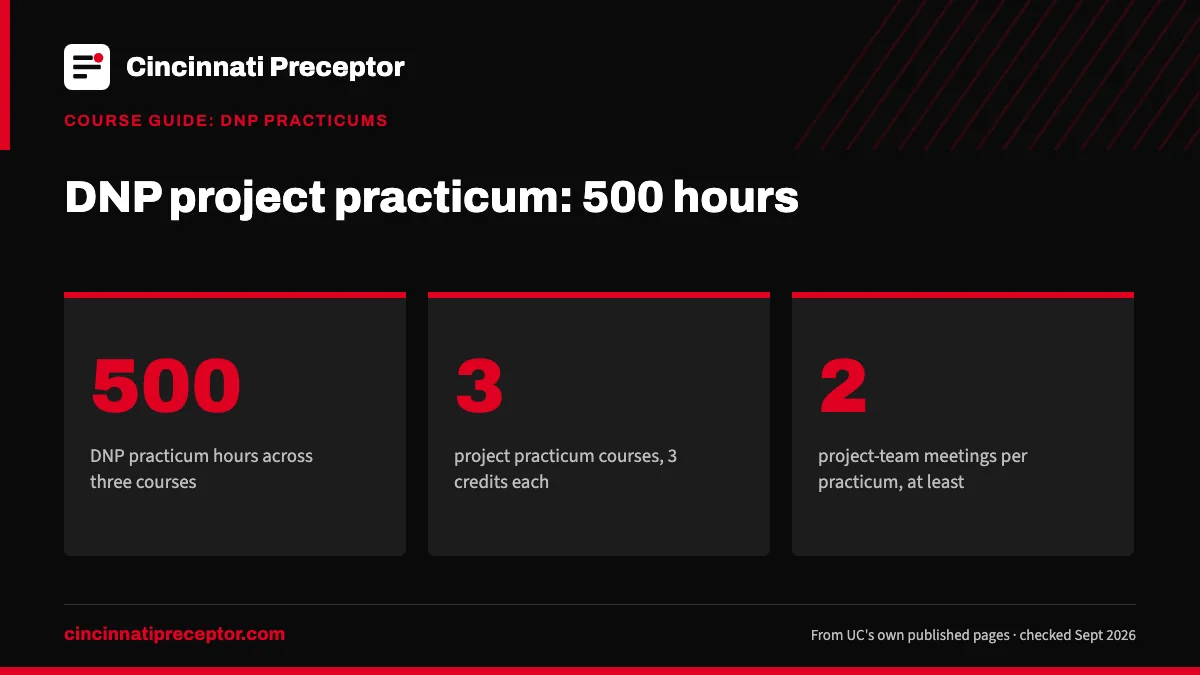
Three courses, 500 hours
UC's DNP Project page says students complete three DNP practicum courses totaling 500 hours. They are project courses, not clinical rotations: each one moves the same project forward, and each requires at least two meetings with your project team. In the post-MSN DNP plan they fall in semesters 2, 3 and 4. For BSN-to-DNP students, these three courses come in addition to the specialty practicums, not in place of them.
| Course | Credits | Post-MSN semester | Milestone |
|---|---|---|---|
NDNP9025 DNP Practicum: Strategy Development | 3 | 2 | Choose the topic and defend the proposal |
NDNP9035 DNP Practicum: Implementation | 3 | 3 | Implement and disseminate the project |
NDNP9038 DNP Practicum: Analysis and Dissemination Planning | 3 | 4 | Final defense |
NDNP9038 shares its semester with NDNP9040, the DNP Leadership Seminar. Some DNP major maps also list NDNP9042, a manuscript writing seminar, as an elective that needs your chair's permission.
500 hours or 504?
Older documents give a different number. UC's DNP Handbook, effective Fall 2019, described 168 immersion hours per practicum, 504 in total, at twelve hours a week. The current DNP Project page says 500 and gives no split by course.
Use 500 as the current figure, and ask your chair how the hours divide across the three courses and how you document them. We found no current UC source that answers either question, and the answer decides how much weekly time you'll need at your project site.
If you are weighing tracks, clinical hours by UC track sets the 500 project hours beside each specialty's clinical total.
500 is UC's current DNP practicum figure; 504 comes from the 2019 handbook. Don't build your schedule around 168-hour blocks until your chair confirms the split.
Choosing a project site
The post-master's DNP is not an NP preceptor search. UC's DNP FAQ notes that most post-MSN students keep full-time jobs and that students' work environments often provide an ideal setting for the project. The 2019 handbook went further: students were to name an inquiry within their practice area when they applied, and projects could partner with a clinical agency or a health department.
A workable site has a problem worth solving, a leader willing to let you test a change, and data you can reach within UC's timeline. Because NDNP9025 is where you defend the proposal, the site conversation belongs before or early in that semester, not during implementation.
Admission, the course sequence and the rest of the program are on UC's post-master's DNP.
Your project team
UC's DNP Project page describes the team as a UC chair plus at least one other UC doctoral faculty member. You choose the topic with faculty advisors, and the team meets with you at least twice in each practicum.
The 2019 handbook described a team of two to four people that could include members from outside the College of Nursing, and said it should include a content expert or clinical mentor. The current page doesn't repeat that, so ask your chair whether a mentor at your site can join the team and what UC needs from them.
The project ends in a public defense and a manuscript submitted to a peer-reviewed journal. Both take planning in the final term, so settle your data access and site approvals in the first two practicums.
What UC leaves unstated
Several practical questions have no public UC answer. Raise them early with your chair and with the Clinical Site Coordinator your program page points you to:
- Whether a project site needs an Educational Affiliation Agreement, as specialty clinical sites do.
- Whether a site mentor completes anything like the Preceptor Application.
- How practicum hours are logged and verified.
- Whether any MSN clinical hours carry into the DNP; UC describes no gap analysis for it.
- How long the post-MSN DNP runs: its major map shows four semesters but lists a five-year duration.
UC doesn't say whether a DNP project site needs an affiliation agreement. Ask before you log project hours at any organization, your employer included. The agreement itself is explained on UC's affiliation agreement.
Orientation, defense and where you can live
Post-MSN DNP students attend a mandatory one- to two-day orientation in their first fall, and there's an optional half-day DNP workshop in summer. The defense is where UC's pages disagree: the DNP FAQ lets students more than a two-hour drive from campus defend virtually, while the post-master's certificate FAQ says students visit campus to defend. Ask your chair which applies to you; other campus dates are on the immersion page.
UC's online DNP programs start in fall only and can't enroll students in Washington or in the seven states closed to UC graduate clinicals. Washington is open to UC's MSN and certificate programs, so that limit catches DNP students in particular. If you might move during the program, check UC state authorization first.
Questions UC students ask
Do I need a preceptor for the UC DNP practicum?
Not an NP preceptor in the clinical sense. UC describes a project team made up of a UC chair and at least one other UC doctoral faculty member. The 2019 handbook allowed an outside content expert or clinical mentor on the team, so ask your chair whether a site mentor is expected and what they need to sign.
Can I do my DNP project where I work?
UC's DNP FAQ says students' work environments often provide an ideal setting for the project, and most post-MSN students keep working full time. Confirm with your chair that the project fits, and ask your CSC whether your employer needs an agreement with UC before you begin logging hours there.
How do BSN-to-DNP students fit in the 500 hours?
They take NDNP9025, NDNP9035 and NDNP9038 in addition to their specialty clinicals, such as the FNP's 672 hours. UC doesn't publish a combined total for any track, so plan the two separately: specialty practicums need approved preceptors, while the project courses run through your team. See UC BSN-to-DNP.
Can I defend my DNP project online?
UC's DNP FAQ says students living within a two-hour drive, about 100 miles, defend in person and others may defend virtually. The post-master's certificate FAQ says students come to campus to defend. Because the two pages differ, ask your chair early which rule applies to your defense.
Do my MSN clinical hours count toward the 500?
UC describes no credit for earlier MSN clinical hours toward the DNP practicum courses. The DNP Project page simply says students complete three practicum courses totaling 500 hours. If you think earlier hours should count, raise it with your program before your first practicum semester.
Related pages
Post-MSN DNPUC's post-MSN DNP: NDNP9025, NDNP9035 and NDNP9038 total 500 practicum hours built around your project. No NP preceptor search; what to line up instead.BSN-to-DNP NP tracksUC's BSN-to-DNP NP tracks pair the specialty clinicals with 500 DNP practicum hours, start in fall only and run three years. How to plan the preceptor search.Clinical hours by UC trackEvery UC College of Nursing track's clinical courses and hours in one table, 504 to 840 per track, plus the term-date, week-2 and NP-supervision rules.NURS8020C immersion and intensivesFrom Spring 2027, UC's NURS8020C health assessment course adds three days on campus. The dates, what happens, and the midwifery, WHNP and PMHNP intensives.UC affiliation agreementHow UC's Educational Affiliation Agreement works: UC's standard form or a site's own contract, the 6-week and 6-month timelines, who handles what, and fees.
Last checked 2026-09-24
We check these pages against UC's own sources. Your Clinical Site Coordinator, your course faculty and UC's current documents have the final word.
Hand us the search. Keep your packet deadline.
Tell us your UC track, where you live and which term your next practicum starts. We look for a preceptor and site that fit UC's rules for your track, and help you get the Preceptor Application and agreement details right.
- Matched to your track's population, setting and hour rules
- Checked against UC's preceptor requirements before your CSC sees it
- Aimed at UC's packet deadline, not just the first day of term
Start your placement plan
A placement advisor replies with what a UC-ready preceptor and site look like for you.