UC's post-MSN DNP: 500 practicum hours built around a project, not a preceptor
UC's post-MSN DNP has no nurse practitioner clinicals to place. Its three practicum courses, NDNP9025, NDNP9035 and NDNP9038, add up to 500 hours of project work guided by a UC chair and faculty team, and UC notes that students' workplaces often suit the project well. What you need instead is a project setting, a topic that setting will support and early answers to a few questions UC leaves open.
Talk through your DNP project setting
Tell us your MSN specialty, where you work and the term your first DNP practicum starts. A placement advisor replies with how we'd find a project setting and practice mentor near you.
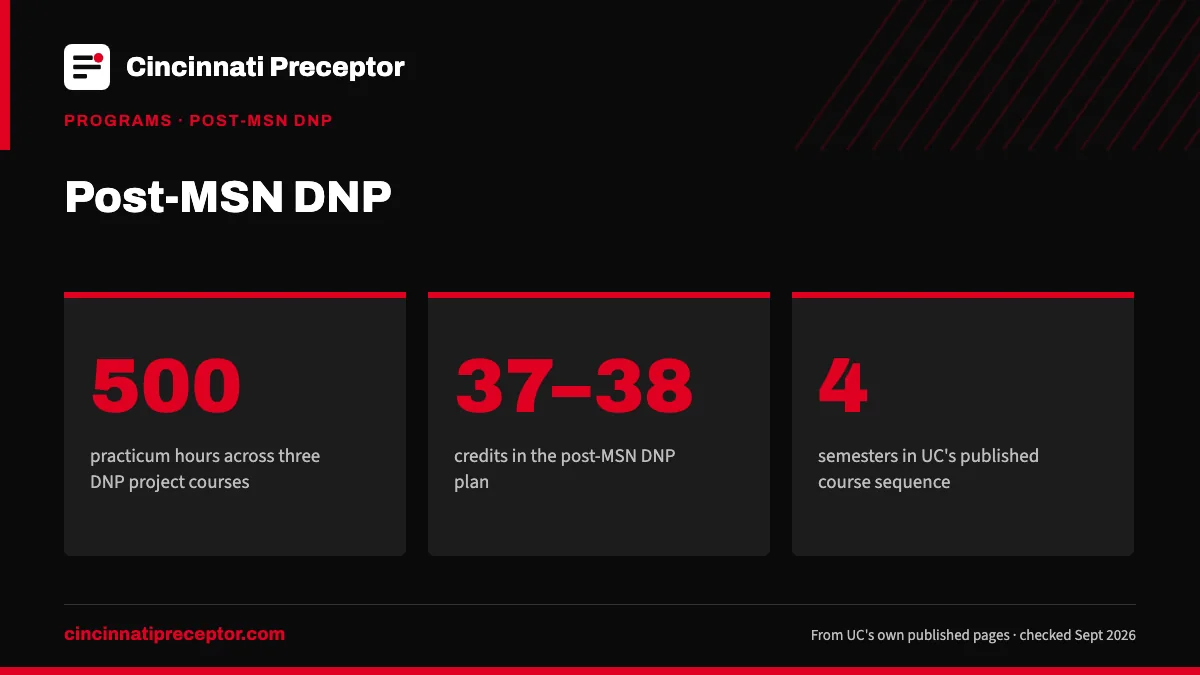
500practicum hours across three DNP project courses
37–38credits in the post-MSN DNP plan
4semesters in UC's published course sequence
Who the post-MSN DNP is for
UC's post-MSN DNP is an online doctorate for nurses who already hold a master's degree in nursing. Applicants need that MSN, an unrestricted RN license and at least one year of RN practice in the US, and UC recommends a graduate GPA of 3.25; the FAQ below lists which master's degrees qualify. If you're entering with a BSN, the BSN-to-DNP page is the one for you.
The program starts in fall only, and UC's DNP FAQ says most post-MSN students keep a full-time work schedule. Campus time is limited: a mandatory orientation of one to two days in your first fall, an optional half-day summer DNP workshop and, for some students, the project defense.
Certified registered nurse anesthetists with an MSN also earn their doctorate through this program. UC's Nurse Anesthesia page says they complete no additional anesthesia practicum hours to do it.
The four-semester course sequence
UC's major map for fall admits lays the program out over four semesters and 37 to 38 credits. The first practicum arrives in the second semester, which leaves little time between admission and your first project term.
| Semester | Courses |
|---|---|
| 1 | NDNP9006 Essentials of Research Methods for EBP, NDNP9001 Informatics, NDNP8004 Developing the DNP Scholar |
| 2 | NDNP9030 Planning, Management, and Evaluation of Programs and Projects, NDNP9025 DNP Practicum: Strategy Development, NDNP9005 DNP Scholarly Writing |
| 3 | NDNP9035 DNP Practicum: Implementation, NDNP9015 Quality Improvement and Patient Safety, NURS8004 Biostatistics for EBP, ANCH8001 Principles of Population Health |
| 4 | NDNP9040 DNP Leadership Seminar, NDNP9038 DNP Practicum: Analysis and Dissemination Planning, NURS9009 Health Care Policy for the Doctoral Prepared Nurse |
Each practicum shares a term with courses that feed it: program planning and evaluation beside the strategy practicum, quality improvement beside implementation. The same major map also prints a duration of five years, which doesn't match its four-semester layout. Ask your advisor how long your own plan runs before you give an organization dates for the project.
500 practicum hours built around a project
UC's DNP Project page says the three practicum courses total 500 hours. You may also come across 504, from a 2019 handbook that set each course at 168 immersion hours, 12 a week. Go by UC's current figure of 500. No current per-course split is published, so ask your chair how hours are counted in each course.
Each practicum has its own job. In the first you settle the topic and defend the proposal; in the second you implement the project and start disseminating it; in the third you hold the final defense. Your project team meets at least twice during each practicum. The end products are a defense open to the public and a manuscript you submit for peer-reviewed publication.
The DNP project practicum page shows how the hours and deliverables fit together across the three courses.
Choosing the project setting and team
According to UC's DNP FAQ, a student's own workplace is frequently the best home for the project, and most post-MSN students have a job to draw on. Formally, your team consists of a UC chair and one or more additional UC doctoral faculty.
The 2019 handbook adds points UC's current pages don't repeat. It describes a project team of between two and four, which can draw on people beyond the College of Nursing and ought to have a subject-matter expert or clinical mentor on it. It allows projects run jointly with an outside organization, a clinical agency or health department for example, and it asked applicants to identify a question from their own practice at the time they applied. Treat those as background and confirm them with your chair.
If your employer can't host the project, or the topic needs a different kind of organization, line up a willing partner before the first practicum, because proposal work starts there. That is a search for an organization and a mentor, not for an NP preceptor.
What UC hasn't spelled out
Several answers that shape your planning aren't on UC's public pages. Get them from your advisor or chair early and keep them in writing.
- Site paperwork. No UC page explains whether these practicums need a site preceptor, a Preceptor Application or an affiliation agreement, as NP clinicals do.
- Credit for earlier hours. No UC page describes counting clinical hours from your MSN toward the DNP.
- Hours per course. Only the 500-hour total is current; the per-course split comes from the 2019 handbook.
- Program length. The major map shows four semesters but a five-year duration.
- Where you defend. One UC FAQ calls for a campus visit; the DNP FAQ allows a virtual defense for students living beyond roughly 100 miles.
Don't assume your MSN clinical hours shrink the 500. UC hasn't published a rule that counts them, so plan for the full total until your advisor tells you otherwise.
State limits, and when students bring us in
UC's online DNP programs are closed to students in the seven states shut to all UC graduate clinicals (AZ, LA, MA, NY, OR, RI and TN), in Washington and in U.S. territories. The Washington exclusion is specific to doctoral programs; UC's master's and certificate students may still train there. A move mid-program means checking the new state before you settle on a project site; the moving page covers what changes.
Why post-MSN students bring us in: when the project can't sit at your own workplace, we find a partner organization and a practice mentor near you whose work fits your topic, and we help you frame the request so the organization knows what it is agreeing to host. Your UC chair and faculty then decide whether the setting and project are acceptable, and they review a proposal that already answers their first questions.
Questions UC students ask
Do post-MSN DNP students at UC need a preceptor?
Not an NP preceptor. The three DNP practicums revolve around your project and are overseen by your UC chair and at least one further member of UC's doctoral faculty. UC's 2019 handbook mentions a subject-matter expert or practice mentor as a team member, and the organization hosting your project may want a named contact. Ask your chair whether your practicum needs any site paperwork.
Can I do my DNP project at my workplace?
In many cases, yes. UC points out that where you already work is often an ideal place for the project. Before you commit, check three things: that your chair thinks the topic suits the organization, that your employer agrees in writing, and whether anything has to be signed before the implementation practicum begins.
When does the first DNP practicum start?
On UC's published plan for fall admits, NDNP9025 Strategy Development falls in the second semester, alongside NDNP9030 and NDNP9005. That is the course where you choose the topic and defend the proposal, so settle the project setting during your first semester. If your own plan of study differs from the published one, go by yours.
Which master's degrees qualify for UC's post-MSN DNP?
UC's DNP FAQ lists master's degrees that lead to NP, CNM or CRNA certification, clinical nurse specialist degrees in community, public or occupational health, and master's degrees in nurse leadership or administration. If your MSN is in another area, ask admissions before applying, since the list is specific.
How often do post-MSN DNP students come to campus?
Rarely. UC lists a mandatory orientation of one to two days in the first fall and an optional half-day workshop in summer. For the defense, the DNP FAQ says students within about 100 miles, roughly a two-hour drive, come in person and others may join virtually, though another UC FAQ describes a campus visit to defend.
Related pages
DNP project practicum: 500 hoursUC's DNP project runs through NDNP9025, NDNP9035 and NDNP9038, 500 practicum hours in all. The project site, team and defense, and what UC leaves open.BSN-to-DNP NP tracksUC's BSN-to-DNP NP tracks pair the specialty clinicals with 500 DNP practicum hours, start in fall only and run three years. How to plan the preceptor search.Systems Leadership (MSN or DNP)UC's Systems Leadership MSN and DNP run ANNA8020, ANNA8022 and ANNA8024 at 168 hours each. Who can precept a nurse leader and how to time the search.State authorizationUC runs graduate clinicals in all but seven states, keeps Washington closed to DNPs, limits three tracks to OH, KY and IN residents and rules out territories.Moving during UC clinicalsRelocating during your UC nursing program? Check state authorization, your RN license, CastleBranch and new preceptors before you move, not after.
Last checked 2026-09-24
We check these pages against UC's own sources. Your Clinical Site Coordinator, your course faculty and UC's current documents have the final word.
Hand us the search. Keep your packet deadline.
Tell us your UC track, where you live and which term your next practicum starts. We look for a preceptor and site that fit UC's rules for your track, and help you get the Preceptor Application and agreement details right.
- Matched to your track's population, setting and hour rules
- Checked against UC's preceptor requirements before your CSC sees it
- Aimed at UC's packet deadline, not just the first day of term
Start your placement plan
A placement advisor replies with what a UC-ready preceptor and site look like for you.