Ohio rules for UC nurse practitioner clinicals
The Ohio Board of Nursing doesn't regulate APRN education programs, so UC's own rules decide most of what happens in your Ohio clinicals. Ohio law still reaches you in four places: a student exemption from licensure, your preceptor's standard care arrangement, the RN license you hold, and a fingerprint-based background check.
Training in Ohio?
Tell us your UC track, term and Ohio city. A placement advisor replies with what an Ohio preceptor search that fits UC's rules looks like.
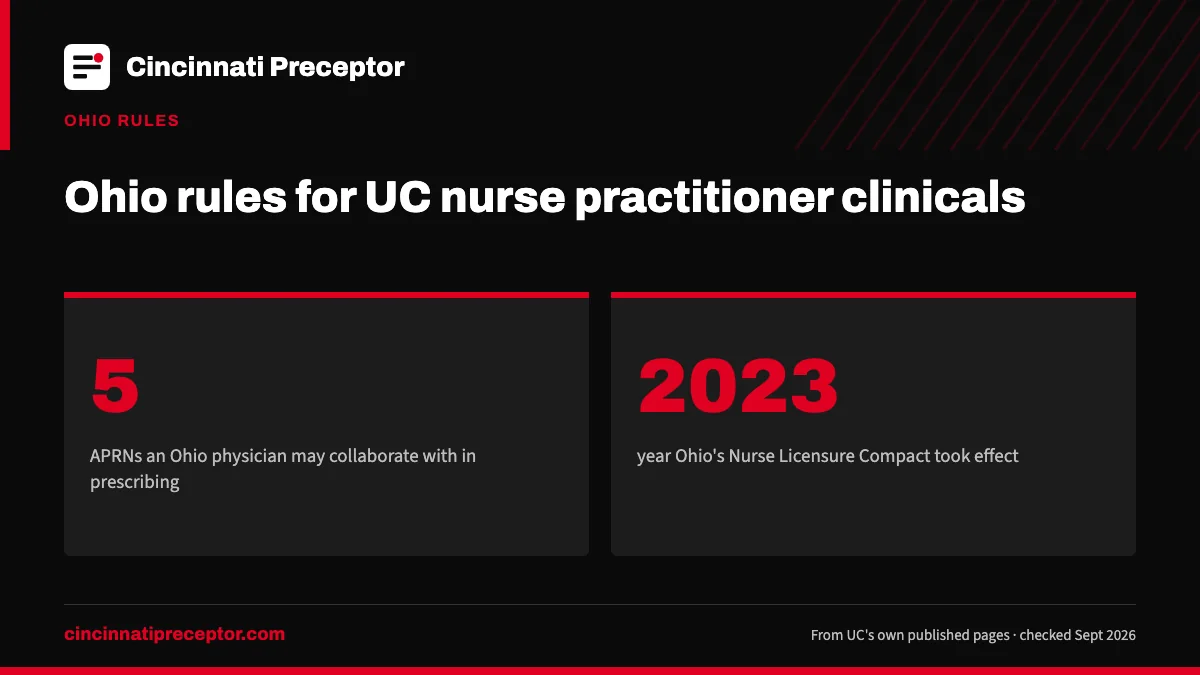
5APRNs an Ohio physician may collaborate with in prescribing
2023year Ohio's Nurse Licensure Compact took effect
Who sets the rules for Ohio clinicals
Start with what the Ohio Board of Nursing says it doesn't do. Its 2025 guide to APRN licensure and practice explains that the Board does not regulate the programs that prepare RNs for APRN licensure and keeps no list of them. Questions about those programs go to the accreditor or to the Ohio Department of Higher Education.
We found no Board approval step for an APRN student's site or preceptor. UC's rules carry the weight instead: its preceptor qualifications, the Preceptor Application, the Educational Affiliation Agreement and the week-2 site deadline. The whole sequence is on the UC clinical placement process.
UC's preceptor guide adds a caveat that holds in any state: if a state regulator sets extra qualifications or limits for clinical preceptors, those take priority over UC's policy. In Ohio, the sections below cover the ones worth knowing.
The student exemption in ORC 4723.32
Ohio law exempts nursing students from licensure for practice that is part of their program. Section 4723.32 of the Ohio Revised Code reaches a student enrolled in a program leading to initial APRN authorization, practicing under the program's auspices and supervised by a nurse who serves the program as faculty, teaching assistant or preceptor.
Read the section's current wording on Ohio's official code site rather than relying on a paraphrase. Summaries differ on which license the supervising nurse must hold, while UC approves physicians as preceptors in Ohio. If a site raises the point, hand it to your Clinical Site Coordinator rather than trying to settle it yourself.
Don't confuse this with the preceptor rules in OAC chapter 4723-5. That chapter, including OAC 4723-5-10 on preceptor qualifications, governs prelicensure RN and PN programs. The Ohio Nurses Association has pointed out that it covers nursing students, not APRN students.
Your preceptor's standard care arrangement
An Ohio nurse practitioner practices under a written standard care arrangement (SCA) with a collaborating physician or podiatrist, as ORC 4723.431 requires. A certified nurse-midwife needs one with a collaborating physician. OAC 4723-8-04 sets out what the document must contain.
What OAC 4723-8-04 requires in an SCA
- A statement of the services offered
- A plan for new technology and procedures
- Quality assurance, including chart review under OAC 4723-8-05 for direct patient care
- An emergency coverage plan and a way to resolve disagreements
- Prescribing parameters
The collaborating physician must be authorized in Ohio and practice in a same or similar specialty; the Board's 2025 FAQ confirms the specialties need not be identical. For psychiatric-mental health NPs, the physician may practice psychiatry, pediatrics, primary care or family practice. One physician may collaborate with no more than five APRNs at once in prescribing.
For you, the SCA explains what your preceptor may do and so what you'll see. It stays on file with the employer and isn't one of the items on UC's Preceptor Application.
Who can precept you in Ohio
UC's preceptor rules apply unchanged in Ohio: an NP, CNM or physician (MD or DO) with certification, at least a year in the role and an active, unencumbered license valid in Ohio, plus a master's degree or higher for nurses. NP tracks still need at least 20% of hours with a certified NP in the population focus. Track rules are on UC preceptor requirements.
One Ohio difference stands out: physician assistants can't precept UC students here. UC allows PAs only in the states on its list, and Ohio isn't one of them.
Some large Ohio organizations coordinate students centrally, and UC asks you to contact your CSC before approaching them: Cleveland Clinic, Nationwide Children's Hospital and The Little Clinic. Cleveland Clinic also writes an administrative fee into its affiliation agreement, which UC collects from the student; see UC clinical site fees. Cincinnati's systems are covered on Cincinnati clinical sites.
Ohio is home ground for UC, and our search here is built around UC's own rules. We look for Ohio NPs, CNMs and physicians who fit your track, route any of the CSC-first organizations through your CSC before anyone makes a call, and flag Cleveland Clinic's fee before you commit. The fingerprint check goes into your timeline early, and your CSC receives a complete Preceptor Application for the final approval.
License and background checks
UC requires a valid RN license in the state where your clinical takes place. Ohio joined the Nurse Licensure Compact effective January 1, 2023, so a multistate license issued by your compact home state is valid here, as is an Ohio license. Individual sites can ask for more: Cincinnati Children's NP practicum, for one, asks for an active Ohio RN license. See RN licenses for UC clinicals.
Ohio also changes your background check. UC's 2026–27 handbook says Ohio residents, and anyone completing clinicals in Ohio, complete a national and state fingerprint-based background check, and Ohio appears on UC's list of states that need a supplemental state check for APRN students. The handbook counts fingerprinting and extra background checks among costs students pay. The process is on UC background check and drug screen.
What Ohio offers preceptors
We found no Ohio tax credit for individual preceptors. Ohio's support goes to organizations instead. A case study by the National Association of Community Health Centers describes the Ohio Primary Care Workforce Initiative: funded by the Ohio Department of Health and run by the Ohio Association of Community Health Centers, it pays federally qualified health centers for each clinical hour of student rotation they support. Nurse practitioner students are among the eligible professions, and centers may use the money to reward staff who precept.
That makes FQHCs worth a look when you search in Ohio, though the program pays the center, not you or your preceptor. Published funding figures vary by source, so ask a center about its current support. A federal bill to give nurse preceptors a tax credit has been introduced in Congress but is not law.
UC itself doesn't pay preceptors. It offers continuing-education webinars, and its preceptor training page links the initiative's preceptor development series.
Questions UC students ask
Does the Ohio Board of Nursing approve my UC clinical site or preceptor?
No. The Board says it doesn't regulate the programs that prepare RNs for APRN licensure. UC's Clinical Site Coordination team vets and approves your preceptor and site, and an affiliation agreement between UC and the site has to be in effect before your hours can count.
Can a physician assistant precept me in Ohio?
Not as a UC student. UC permits PA preceptors only in the states on its list, case by case and for limited hours, and Ohio isn't on that list. An NP, CNM or physician can precept you in Ohio, subject to UC's usual qualifications and your track's own rules.
Do I need an Ohio RN license for clinicals in Cincinnati?
You need an RN license that is valid in Ohio. Ohio has been part of the Nurse Licensure Compact since January 1, 2023, so a multistate license from your compact home state qualifies, and so does an Ohio license. Some sites want an Ohio license specifically; Cincinnati Children's NP practicum is one.
Do Ohio residents need fingerprinting even if their clinicals are in Kentucky?
UC's handbook applies the fingerprint-based national and state check to Ohio residents as well as to anyone training in Ohio, so an Ohio resident with a Kentucky site still completes it. Kentucky itself isn't on UC's supplemental check list; the details are on Kentucky and Indiana clinicals.
Is there an Ohio tax credit for NP preceptors?
We found none for individual preceptors. Ohio's support runs through the Primary Care Workforce Initiative, which funds federally qualified health centers per clinical hour of student rotation. A federal preceptor tax credit bill has been introduced but has not become law, so a preceptor should check with a tax professional before counting on any credit.
Related pages
Cincinnati health systems and NP studentsHow UC Health, TriHealth, Christ Hospital, Mercy Health, St. Elizabeth and Cincinnati Children's take NP students, per their own pages. UC approves each site.Kentucky and Indiana clinicalsUC clinicals in Northern Kentucky or southeast Indiana: preceptor licenses, PA rules, compact licenses, background checks and what neither state settles.OhioOhio is UC's home state and open to every UC track. Plan for a fingerprint check, no PA preceptors and four systems your CSC must hear about before you do.Background check and drug screenWhat UC's nursing background check covers, why UC documents describe the drug screen two ways, Ohio's fingerprint check and the 18 states with extra checks.Physician assistant preceptorsUC lets physician assistants precept NP students only in listed states, case by case and for limited hours. The state list, the midwifery cap, what to check.UC preceptor requirementsUC's preceptor rules: master's or higher, accepted certification, a year in the role, a clean license in the clinical state, and the 20% NP and 50% CNM rules.
Last checked 2026-09-24
We check these pages against UC's own sources. Your Clinical Site Coordinator, your course faculty and UC's current documents have the final word.
Hand us the search. Keep your packet deadline.
Tell us your UC track, where you live and which term your next practicum starts. We look for a preceptor and site that fit UC's rules for your track, and help you get the Preceptor Application and agreement details right.
- Matched to your track's population, setting and hour rules
- Checked against UC's preceptor requirements before your CSC sees it
- Aimed at UC's packet deadline, not just the first day of term
Start your placement plan
A placement advisor replies with what a UC-ready preceptor and site look like for you.