UC clinicals in Kentucky and Indiana
Greater Cincinnati runs into Northern Kentucky and southeast Indiana, and UC treats all three states as its home region for clinical partnerships. Crossing a state line changes a few things: which clinicians can precept you, which license your preceptor needs, and which background checks apply. A couple of Kentucky and Indiana questions have no clear public answer, and this page flags them.
Training across the river?
Tell us your UC track, term and the Kentucky or Indiana area you can reach. A placement advisor replies with what a search there involves.
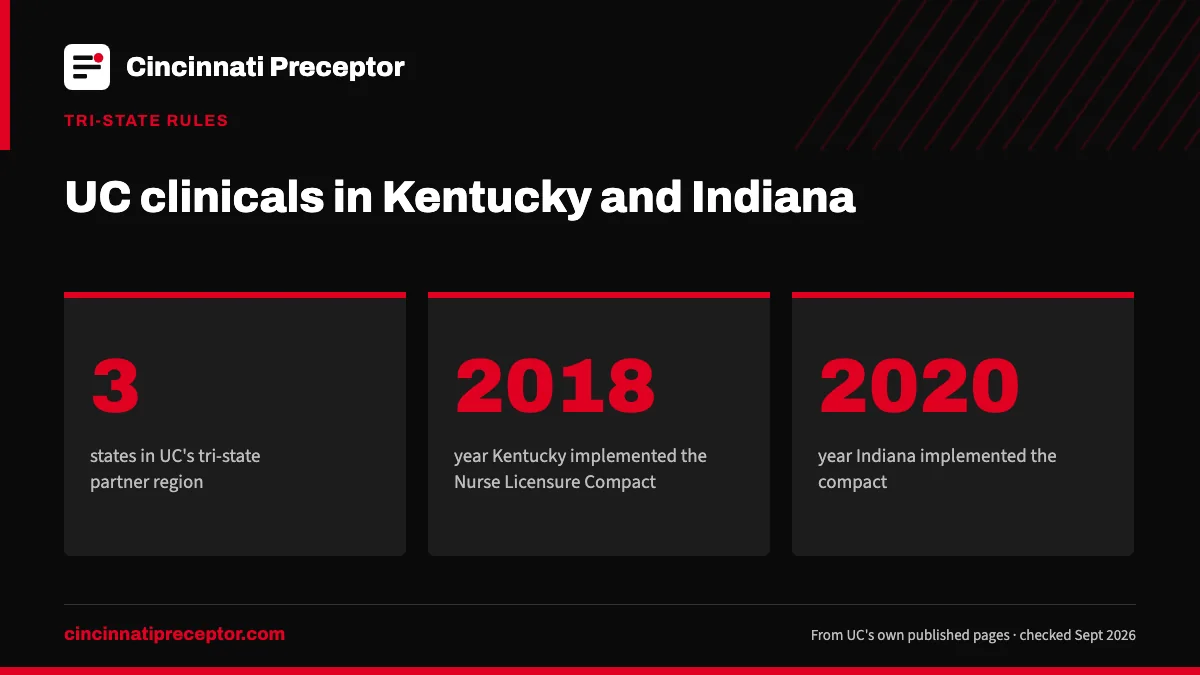
3states in UC's tri-state partner region
2018year Kentucky implemented the Nurse Licensure Compact
2020year Indiana implemented the compact
Why UC treats the tri-state as home
UC's 2026–27 handbook defines its Ohio/Tri-State area as Ohio, Kentucky and Indiana. The college holds clinical partnerships there, and when a student's own search stalls, outreach by the Clinical Site Coordinator may lead to a site in that region, even if it means travel. UC's preceptor awards keep a separate tri-state category too.
Three UC programs admit only residents of these states: the adult-gerontology acute care NP in every format, and the post-master's certificates in adult-gerontology primary care and pediatric acute care. For students in those programs, a Kentucky or Indiana site is often the closest option rather than a fallback. What your CSC can do when a search stalls is on UC placement help.
Neither Kentucky nor Indiana is on UC's list of states closed to graduate clinicals. Tennessee, further south, is.
Students weighing a site across the river bring us in for exactly these questions. We search Northern Kentucky and southeast Indiana as closely as Cincinnati itself, confirm that each preceptor holds the license the site's state requires, and suggest a PA only on the Kentucky side, where UC allows one. The Preceptor Application your CSC receives then already answers the state-line points below.
What changes at the state line
The table lines up the three states on the points that change a UC student's plan.
| Point | Ohio | Kentucky | Indiana |
|---|---|---|---|
| UC allows clinicals | Yes | Yes | Yes |
| PA preceptors under UC rules | No | Yes, case by case, limited hours | No |
| UC supplemental state background check | Yes, plus fingerprinting | Not listed | Not listed |
| Nurse Licensure Compact | Since January 1, 2023 | Implemented January 19, 2018 | Implemented July 1, 2020 |
| State board and UC's graduate program | Doesn't regulate APRN programs | Doesn't approve out-of-state programs | Doesn't review graduate programs |
| NP prescribing with a physician | Standard care arrangement | CAPA-NS, plus CAPA-CS for controlled substances | Collaborative agreement, per AANP; confirm current law |
Your RN license, too, has to work in the site's state. All three states belong to the compact, so one multistate license issued where you live works across the metro, while a single-state license stops at its own border. More on RN licenses for UC clinicals.
Kentucky: board oversight and your preceptor's license
Kentucky's Board of Nursing leaves schools based elsewhere alone: by its own account it neither approves them nor expects them to apply, and that holds when they send students to Kentucky sites. Its oversight covers prelicensure programs that start in Kentucky. A statute, KRS 314.101, also exempts a nurse licensed elsewhere who comes to Kentucky for a clinical rotation, as long as the school is a SARA institution or holds a license from Kentucky's Council on Postsecondary Education.
The Kentucky rule most likely to affect your search concerns your preceptor. For online APRN programs, the Board says faculty who oversee students in Kentucky clinical settings, and preceptors working in Kentucky, need an active, unencumbered Kentucky RN license and a Kentucky APRN license. If they make their home in another compact state, the Kentucky APRN license alone is enough. That lines up with UC's own rule that preceptors be licensed in the state where you train, so ask about it in your first conversation with a Kentucky NP.
Kentucky's preceptor-sourcing rule is unsettled
Kentucky's rule on APRN program standards, 201 KAR 20:062, makes the program responsible for securing preceptors for its students, says a student can't be required to find their own, and lets students have input. That reads very differently from UC's expectation that you find and secure your preceptor.
The open question is whether the rule reaches an out-of-state program like UC placing a student in Kentucky. The version on record is silent on that, the official state copy wouldn't load, and the Board's statement about out-of-state programs doesn't answer it directly. Don't present the rule to UC as settled. If it matters to your plan, ask your CSC how UC reads it.
Kentucky's 201 KAR 20:062 puts preceptor sourcing on the program, but no source says it covers UC. Treat it as an open question for your CSC, not as a right.
Kentucky practice, PAs and preceptor perks
Kentucky NPs prescribe under collaborative agreements with a Kentucky physician in a same or similar specialty: a CAPA-NS for non-controlled drugs and a CAPA-CS for controlled substances. Either can end or be exempted after four years. These agreements shape your preceptor's prescribing, not your status as a student.
Kentucky is the only one of the three states where UC lets a physician assistant precept, case by case and for limited hours. Nurse-midwifery students are capped at 20 PA hours in ANW8006, with director approval. See UC's PA preceptor rules.
Kentucky rewards precepting for RNs and LPNs: 120 or more one-to-one hours count as 14 contact hours toward continuing competency on the Board's form. The form tells APRNs not to submit it, so an NP preceptor can't use it. St. Elizabeth Healthcare, the Northern Kentucky system in the regional placement network, is covered on Cincinnati clinical sites; Norton Healthcare in Louisville is on UC's list of systems to clear with your CSC first.
Indiana: fewer rules, one open question
Indiana's nursing board limits its accreditation work to schools preparing students for a first RN or LPN license. By its own statement, RN-to-BSN and graduate programs fall outside that review. We saw no Indiana approval that a graduate school from another state must obtain before sending students to Indiana sites, and no Indiana rule aimed at visiting APRN students.
So UC's rules do most of the work in Indiana. PAs can't precept UC students there, Indiana isn't on UC's supplemental background check list, and your preceptor must be licensed to practice in Indiana. AANP describes Indiana NPs as working under a collaborative agreement with a physician; ask your preceptor how that arrangement works at their practice in 2026.
Sources disagree on whether Indiana offers a preceptor tax credit. One reports that a proposed credit failed to advance; another says a credit exists. Until Indiana settles it in public, treat the credit as unconfirmed; a tax professional can tell your preceptor what applies.
Questions UC students ask
Does Kentucky law require UC to find my preceptor?
Not clearly. Kentucky's 201 KAR 20:062 makes APRN programs responsible for securing preceptors, but the version on record doesn't say it reaches a school based in Ohio, and the Kentucky Board describes itself as not approving schools from outside Kentucky. UC's own rule is that you find and secure your preceptor. Ask your CSC if you think the Kentucky rule affects you.
Can a physician assistant precept me in Kentucky?
Yes, case by case. Kentucky is on UC's list of states where a PA may precept, for limited hours and with approval. Ohio and Indiana are not, so a PA who practices on both sides of the river could precept you only at the Kentucky location.
Does my Kentucky preceptor need a Kentucky license?
Yes. UC requires a preceptor licensed where the clinical happens, and the Kentucky Board expects preceptors for online APRN programs to hold both a Kentucky RN and a Kentucky APRN license. For a preceptor whose home is in another compact state, the Kentucky APRN license is the only one required. Physician preceptors need a Kentucky license to practice.
Is there an Indiana tax credit for NP preceptors?
Sources conflict. An Indiana University project reported that a proposed credit did not advance and that none was active as of December 2024, while a third-party site says one exists. With the record split, treat any credit as unconfirmed, and have your preceptor ask a tax professional before relying on it.
Do I need an extra background check for Kentucky or Indiana clinicals?
Neither state is on UC's list of states that need a supplemental state background check. Ohio is, and UC's handbook also requires a fingerprint-based check for Ohio residents, so an Ohio resident training in Kentucky still completes it. Sites can add checks of their own during onboarding. See UC background checks.
Related pages
KentuckyKentucky is open to every UC track and allows PA preceptors under UC's rules, but KBN wants Kentucky APRN licenses and Norton goes through your CSC.IndianaIndiana residents can take every UC program, the tri-state tracks included. UC adds no Indiana form, but PAs can't precept here. Board, license and sites.Ohio rules for NP clinicalsWhat Ohio law means for UC NP students training in Ohio: the Board's limited role, standard care arrangements, fingerprint checks and who may precept you.Cincinnati health systems and NP studentsHow UC Health, TriHealth, Christ Hospital, Mercy Health, St. Elizabeth and Cincinnati Children's take NP students, per their own pages. UC approves each site.Physician assistant preceptorsUC lets physician assistants precept NP students only in listed states, case by case and for limited hours. The state list, the midwifery cap, what to check.State authorizationUC runs graduate clinicals in all but seven states, keeps Washington closed to DNPs, limits three tracks to OH, KY and IN residents and rules out territories.
Last checked 2026-09-24
We check these pages against UC's own sources. Your Clinical Site Coordinator, your course faculty and UC's current documents have the final word.
Hand us the search. Keep your packet deadline.
Tell us your UC track, where you live and which term your next practicum starts. We look for a preceptor and site that fit UC's rules for your track, and help you get the Preceptor Application and agreement details right.
- Matched to your track's population, setting and hour rules
- Checked against UC's preceptor requirements before your CSC sees it
- Aimed at UC's packet deadline, not just the first day of term
Start your placement plan
A placement advisor replies with what a UC-ready preceptor and site look like for you.