Your UC Clinical Site Coordinator: what the role covers and what stays with you
Your Clinical Site Coordinator (CSC) is the UC staff member who vets and approves your preceptor and site, processes the placement paperwork, puts the affiliation agreement in place and opens your eMedley access. The CSC is not a placement agent. At UC the search is still yours, and the coordinator brings other options when your own networking runs dry.
Get your UC placement plan
Your UC track and where you live. A placement advisor replies with what a UC-ready preceptor and site look like for you.
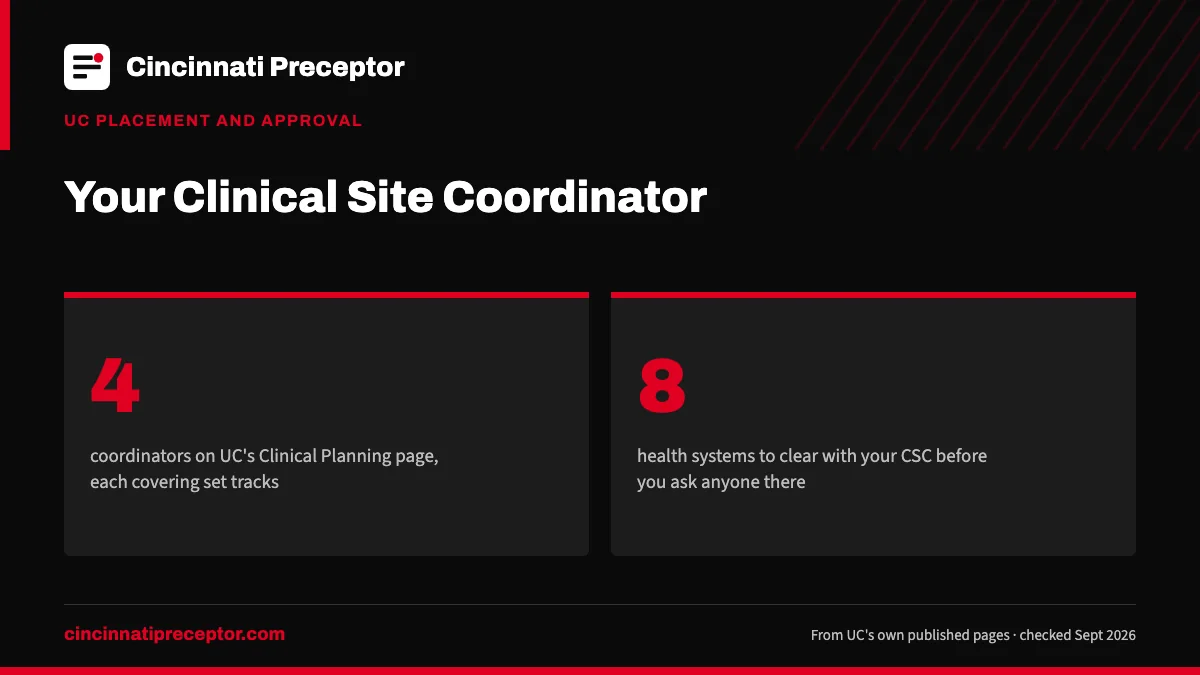
4coordinators on UC's Clinical Planning page, each covering set tracks
8health systems to clear with your CSC before you ask anyone there
What UC means by a Clinical Site Coordinator
Clinical Site Coordinator is UC's own title, and together the coordinators make up the Clinical Site Coordination team. UC's clinical planning glossary and Key Contacts page give them a defined remit: vet and approve preceptors and clinical sites, process placement paperwork, handle affiliation agreements and give students access to eMedley.
Every graduate track has an assigned coordinator, and from your first placement question to the day your site is cleared, that person is your route into UC. The 2026–27 Student Handbook says all placement communication goes through the assigned Clinical Site Coordination Team member, who works with you toward an approved placement.
The CSC works beside other UC roles rather than replacing them. Your faculty advisor or program director decides whether a site suits the course, and for UC Online programs, Student Success Coordinators serve as your academic advisors.
What your CSC takes care of
- Vetting and approval. Checking each preceptor and site against UC's rules and approving them. The approval reaches you as a welcome email.
- Paperwork in the order it arrives. UC's 2022 clinical expectations document says coordinators process files in the order received, one reason an early packet helps.
- The agreement. Supplying UC's standard Educational Affiliation Agreement, sending it to whoever handles contracts at the site, and putting it in place.
- School documents for onboarding. The Letter of Good Standing, liability and malpractice verification, and a compliance summary when a site asks for one.
- eMedley access. Setting you up in the system where you log hours and collect evaluations.
- Options when you're stuck. Talking through sites that may be outside your preferred area, and passing along past UC preceptors and graduates based in your state.
- Obstacles along the way. Helping you work through problems that come up before and during placement.
Several of these have their own pages here: the affiliation agreement, site onboarding and what UC does when your search stalls.
What stays with you
The search itself. UC's Key Contacts page expects you to find and secure a preceptor who meets the mandatory requirements, and the coordinator doesn't open a search for you unless your own has run out. Students report the same thing on public forums, describing UC as able to make some connections but not to place them close to home.
Your coordinator also can't bend UC's limits. Per the handbook, placements are limited and carry no promise of your preferred area; your job, housing and family commitments don't factor into them; and if you decline a placement the college arranges, it doesn't have to offer a second one.
And the file only moves when your pieces are in. Your section of the Preceptor Application, the site's onboarding modules and your CastleBranch items are yours to finish, and the coordinator can't approve around a gap in any of them.
Other UC offices and roles you'll hear about
- Office of Clinical Placement and Operations. Sets the Critical Requirements deadlines you meet in CastleBranch. The handbook also refers to a Senior Assistant Dean for Clinical Placement and Operations.
- Faculty advisor or program director. Approves whether a site or preceptor is appropriate for the course and signs off on track exceptions, such as a midwifery student precepting at their own workplace.
- Course faculty. Reach out to you and your preceptor once the rotation starts, and confer with you both at least twice a semester.
- Student Success Coordinators. Academic advisors for UC Online programs, and the people to ask about your plan of study if a clinical course has to move.
- Shared mailboxes. UC names two you may need: constateauth@uc.edu, for the extra state paperwork California, North Dakota and Wyoming require, and conemedley@uc.edu, for eMedley login or account-merge trouble.
Which coordinator covers your track
UC's Clinical Planning page and the May 2026 Preceptor Guide list four coordinators, each covering a group of programs. Assignments change, so take names and contact details from the current listing on UC's page.
- One coordinator covers AGACNP, AGPCNP, the FNP post-master's certificate and FNP DNP, and Neonatal NP.
- One covers the FNP MSN and Nursing Education.
- One covers Nurse-Midwifery, Pediatric Acute Care NP and WHNP.
- One covers PMHNP, Public Health, Systems Leadership and Occupational Health.
The Clinical Planning page and the Key Contacts page put Pediatric Acute Care NP under different coordinators. If you're in PNP-AC, confirm who yours is before you send a packet or an outreach question. FNP students should check too: the FNP MSN sits with a different coordinator from the FNP certificate and FNP DNP.
Working well with your CSC
- Write rather than call. UC's expectations document treats email as the primary channel and asks you to allow three business days for a reply.
- Ask before approaching the big systems. Clear Allina, Cleveland Clinic, Essentia, Nationwide Children's, Norton, The Little Clinic, Stanford Health Care and Summa Health with your CSC first.
- Confirm the packet address. UC documents give more than one destination for the Preceptor Application, so use whichever your CSC names.
- Send complete details once. Your track, the term, the preceptor's credentials and the site's administrative contact in one message saves a round of follow-up.
- Speak up early. A preceptor who withdraws or a site that wants its own contract changes your timeline, so tell your coordinator as soon as you know.
- Read the welcome email closely. It may mention added requirements from the site.
Students bring us in upstream of all this. We find a preceptor and site that fit your track, gather the credentials and the site's administrative contact, and help you finish your section of the Preceptor Application, so your coordinator gets one complete message instead of a string of follow-ups. Your CSC vets and approves, and we hand over a file built for that review. Tell us your track and term to start.
Send placement questions to your assigned coordinator, not to course faculty or another CSC. The handbook routes all placement communication through that one person.
Questions UC students ask
How do I find out who my UC Clinical Site Coordinator is?
UC lists coordinators by track on the graduate Clinical Planning page and in the May 2026 Preceptor Guide, and UC Online program pages name a Clinical Site Coordinator among your contacts. Where pages disagree, as they do for Pediatric Acute Care NP, ask your Student Success Coordinator or the listed coordinator to confirm before you send paperwork.
Will my CSC find a preceptor for me?
Not at the start. UC expects you to network and secure a preceptor yourself. If that fails, your CSC works with you on alternatives, possibly far enough away to mean travel, and can pass along names of past UC preceptors and graduates living in your state. Take any placement the college arranges seriously, since declining it may leave you without another offer.
How long does a UC Clinical Site Coordinator take to reply?
UC's 2022 clinical expectations document asks students to allow three business days for email replies. Because coordinators process paperwork in the order received, a file sent early sits nearer the front of the line than one sent on deadline day. One complete message with every detail tends to move faster than several partial ones.
Is the Clinical Site Coordinator the same as my academic advisor?
No. For UC Online programs, Student Success Coordinators are the academic advisors who handle your plan of study, while the Clinical Site Coordinator handles preceptors, sites, agreements and eMedley access. UC Online program pages list both, along with an Enrollment Services Advisor. If a clinical course has to move to a later term, expect to talk to both.
Can my preceptor deal with my CSC directly?
Yes, for parts of the process. Your preceptor emails the completed Preceptor Application packet to UC, and the coordinator routes the agreement to the site's contracts contact and can supply UC's liability verification. Ask to be copied on those messages so you know where your file stands.
Related pages
UC clinical placement processThe UC College of Nursing placement path in order: you find the preceptor, your CSC vets it, then the packet, agreement, onboarding and the week-2 cutoff.UC placement helpWhat your UC Clinical Site Coordinator can offer when your preceptor search stalls, why you should accept a site UC arranges, and how we get the search done.UC Preceptor ApplicationHow UC's Preceptor Application works: your student section first, what the preceptor fills in, when a CV is required, and which address the packet goes to.UC affiliation agreementHow UC's Educational Affiliation Agreement works: UC's standard form or a site's own contract, the 6-week and 6-month timelines, who handles what, and fees.Clinical site onboardingSite onboarding for UC clinicals: the platforms UC names, the Letter of Good Standing and liability verification your CSC sends, and systems to clear first.
Last checked 2026-09-24
We check these pages against UC's own sources. Your Clinical Site Coordinator, your course faculty and UC's current documents have the final word.
Hand us the search. Keep your packet deadline.
Tell us your UC track, where you live and which term your next practicum starts. We look for a preceptor and site that fit UC's rules for your track, and help you get the Preceptor Application and agreement details right.
- Matched to your track's population, setting and hour rules
- Checked against UC's preceptor requirements before your CSC sees it
- Aimed at UC's packet deadline, not just the first day of term
Start your placement plan
A placement advisor replies with what a UC-ready preceptor and site look like for you.